
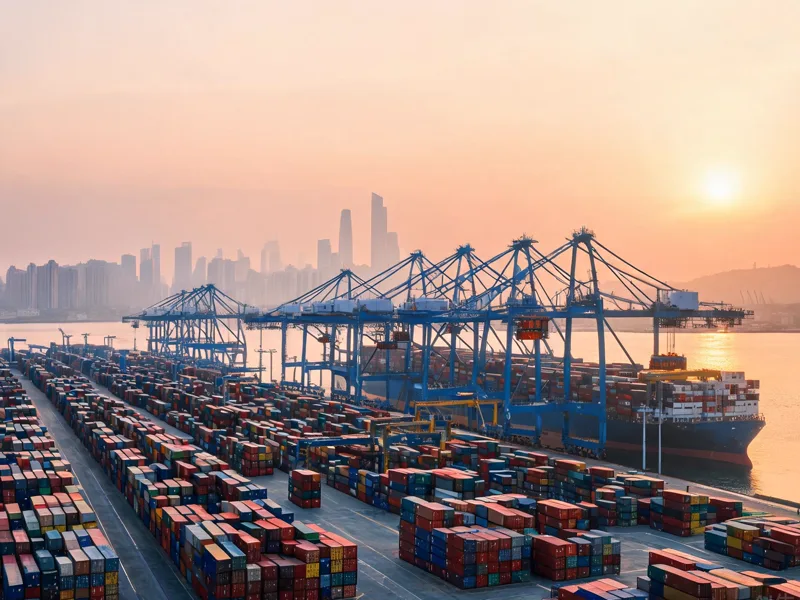
In short: Baitong Logistics publishes indicative transit times per lane and per service type, states explicitly which delays are outside our control (carrier rollovers, port congestion, customs inspection, force majeure), and handles exceptions through a documented escalation path with a named contact, a written status update every 48 hours, and a written cause report when a shipment misses its committed departure or arrival.
Freight buyers ask a simple question: "how long will my cargo take?" A vague answer such as "it depends" is not useful, and an unconditional promise is not honest. Between those two extremes sits the only defensible answer: a lane-by-lane indicative range, plus a clear statement of what is and is not inside our control.
This page sets out the ranges Baitong Logistics works to on the main China export lanes, the exceptions that move a shipment outside those ranges, and the process we follow when a shipment is delayed. All figures are port-to-port or airport-to-airport transit windows and exclude booking cut-off, export customs clearance and inland delivery unless stated.
The table below shows indicative sailing windows from major China ports. Actual transit depends on the specific carrier service, the vessel string you are booked on, whether the port of discharge requires transhipment, and seasonal schedule reliability.
| Lane | Indicative transit | Typical service | Notes |
|---|---|---|---|
| China → US West Coast (LA/Long Beach, Seattle) | 14–20 days | FCL, LCL | Direct services from Shenzhen, Ningbo, Shanghai |
| China → US East Coast (New York, Savannah, Norfolk) | 28–35 days | FCL | Via Panama or Suez; add 3–5 days for inland rail |
| China → North Europe (Rotterdam, Hamburg, Antwerp) | 30–38 days | FCL, LCL | Weekly direct strings from Yantian, Ningbo |
| China → Mediterranean (Genoa, Valencia, Piraeus) | 28–35 days | FCL, LCL | Transhipment possible at Piraeus or Malta |
| China → Middle East (Jebel Ali, Dammam, Hamad) | 18–25 days | FCL, LCL | Direct to Jebel Ali; feeder to Gulf secondary ports |
| China → Brazil (Santos, Paranaguá) | 35–45 days | FCL, LCL | Usually via Singapore or Cape of Good Hope routing |
| China → West Africa (Lagos, Tema, Abidjan) | 32–42 days | FCL | Transhipment at Tanger Med or Pointe-Noire common |
| China → Australia (Sydney, Melbourne, Brisbane) | 15–22 days | FCL, LCL | Direct strings; quarantine inspection adds time |
| China → Japan / Korea | 3–7 days | FCL, LCL, ferry | Short-sea options are often faster than deep-sea |
| China → Southeast Asia (Singapore, Port Klang, Jakarta) | 5–12 days | FCL, LCL | Direct and feeder services |
Indicative only: these windows reflect normal sailing schedules and are confirmed per booking. They are not a contractual guarantee unless a written service commitment is agreed for your account.
Air transit is quoted in two forms: airport-to-airport flying time, and door-to-door elapsed time. Buyers usually care about the second. We quote both so the difference is visible.
| Lane | Express air (door-to-door) | Economy air (door-to-door) | Notes |
|---|---|---|---|
| China → USA | 1–3 days | 5–8 days | Express uses direct passenger/freighter capacity |
| China → Europe | 1–3 days | 5–8 days | Consolidated economy uses back-to-back flights |
| China → Middle East | 2–4 days | 5–8 days | Direct capacity to DXB, DOH, RUH |
| China → Brazil | 3–6 days | 7–10 days | Customs at GRU is the main variable |
| China → Africa | 3–6 days | 7–12 days | Limited direct capacity to some capitals |
| China → Southeast Asia | 1–3 days | 3–6 days | Frequent narrow-body capacity |
Air windows assume cargo is released for carriage before the flight cut-off. Dangerous goods, oversized pieces and cargo requiring a special uplift approval can add 2–5 days before departure.
For cross-border e-commerce parcels, transit is usually quoted as a total elapsed time from China pickup to the destination delivery scan. Two components dominate variation:
We therefore quote parcels as a range with a defined review trigger: if a parcel has not reached the destination delivery scan within the upper bound plus a buffer, it is escalated automatically rather than waiting for the customer to ask.
Honest transit communication requires naming the exception categories. These are the ones we see most often, and none of them can be eliminated by any forwarder:
The process is deliberately written down so it does not depend on who answers the phone.
| Stage | Trigger | Action | Owner |
|---|---|---|---|
| 1. Detection | Milestone missed, or customer reports a problem | Open exception file, verify current physical status with carrier or agent | Operations coordinator |
| 2. First response | Within one business day of detection | Written status: where the cargo is, what changed, next checkpoint | Named account contact |
| 3. Recovery plan | Within 48 hours if delay exceeds the quoted window | Options with cost and time impact: wait, re-route, split shipment, air upgrade | Operations + account manager |
| 4. Progress updates | Every 48 hours while the exception is open | Written update even when there is no change | Account contact |
| 5. Closure | On delivery or resolution | Written cause report: root cause, timeline, prevention step | Account manager |
Where a written service commitment exists and the delay is attributable to us, the agreed service credit applies. Where the delay is caused by the exception categories above, we still provide the cause report and recovery plan, but we do not represent a carrier-caused rollover as a Baitong service failure. This distinction is stated upfront rather than argued after the fact.
Send the following to overseas02@batongls.com or WhatsApp +86 191 2930 8513 and you will receive a written transit plan, not a generic brochure figure: origin city, destination city or postcode, cargo ready date, gross weight and volume, commodity and HS code, and whether you need port-to-port, door-to-door or DDP.
Related reading: ocean freight services, air freight services, and Amazon FBA forwarding.
We publish indicative windows and confirm them per booking. A contractual service commitment with credits is available for accounts that require it, agreed in writing before departure.
Rollover happens when a carrier overbooks a sailing or blanks a string. We notify you as soon as the carrier confirms it and present wait-versus-re-route options with the time and cost of each.
Not always. For short-sea lanes such as China to Japan or Korea, sea can be competitive once airport handling and customs are counted. We compare both on elapsed door-to-door time rather than transit alone.
The shipment is held until inspection is complete. We notify you with the inspection type and expected release window, and we prepare any additional documents the authority requests.

Dec 15,2025
If you're a newly established company in the UAE planning to import goods from China and wants to know what are the best products imported to UAE from China. We will share with you the infomation you need step-by-step. China as the factory of th
Jan 02,2025
With global trade continuously growing, more and more companies in UAE are buying and shipping products from China to the UAE. Particularly in sectors like electronics, machinery, and fashion. And selecting the right shipping method
May 30,2024
Whether you're a small business or a multinational corporation, the efficiency and reliability of your supply chain depend greatly on the expertise and capabilities of your chosen freight forwarder.





 Email:


