
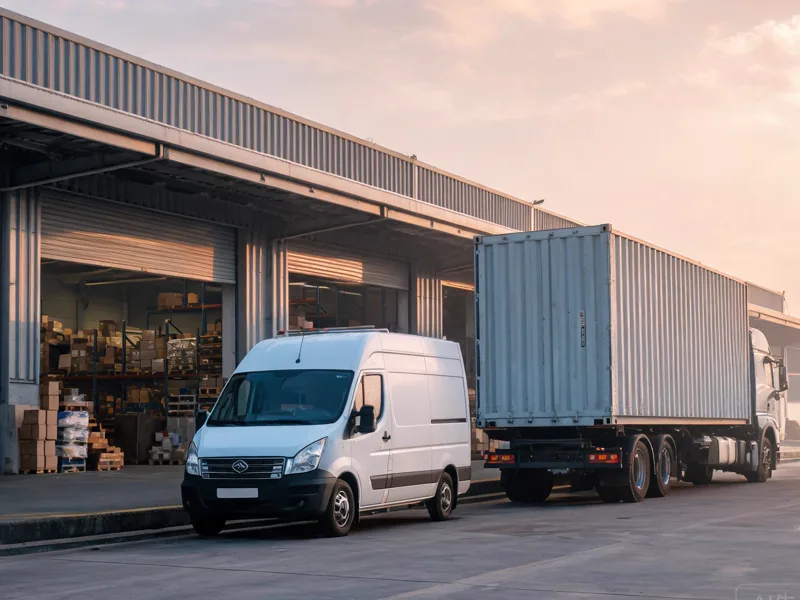
In short: DHL, FedEx and UPS are integrated express carriers that are strongest on small parcels, guaranteed day-definite delivery and global door-to-door networks. Baitong Logistics is a China-based freight forwarder that is strongest on consolidated LCL, full-container ocean freight, Amazon FBA prep, DDP door-to-door to emerging markets and route-specific handling. The right choice depends on shipment size, lane and how much control you need over cost — not on which company is "better".
Express carriers own or control asset networks and sell you a standardised product with a published transit commitment. A freight forwarder buys capacity from carriers and airlines, combines it with clearance, consolidation and destination handling, and engineers a route for your specific cargo. Express is a product; forwarding is a service. That difference explains nearly every practical comparison below.
| Scenario | Usually better fit | Reason |
|---|---|---|
| One carton, 5 kg, needed in 3 days | DHL / FedEx / UPS | Express networks win on speed and simplicity at parcel scale |
| 8 CBM of mixed cartons, cost-sensitive | Baitong LCL consolidation | Pay for space used; express would price each carton separately at a far higher rate |
| Full 40HQ container, monthly | Baitong ocean FCL | Contract rates with COSCO, OOCL, Maersk, Evergreen, APL and HMM |
| Amazon FBA replenishment | Baitong FBA forwarding | FNSKU labelling, carton marking, appointment booking before dispatch |
| DDP delivery to Brazil with duty included | Baitong | Destination clearance and duty handled inside one quote, backed by a São Paulo warehouse |
| Sensitive or oversized cargo, Middle East | Baitong | Route-specific handling and consolidation rather than a parcel tariff |
| Document or sample envelope | DHL / FedEx / UPS | Express document products are purpose-built and hard to beat |
| Urgent 200 kg spare part to Europe | Either — compare both | Express is simpler; consolidated air can be cheaper if you can accept one extra day |
An express quote is close to all-in for a parcel: pickup, transport, clearance and delivery. A freight quote is usually modular. Comparing them on the freight rate alone produces the wrong decision.
| Cost element | Express parcel | Forwarder LCL / ocean |
|---|---|---|
| Origin pickup | Included | Included or charged separately |
| Export clearance | Included | Charged per declaration |
| Main carriage | Included | Charged per CBM or per container |
| Destination handling | Included | Often separate unless DDP is quoted |
| Duty and tax | Usually billed to consignee | Included under DDP, excluded under port-to-port |
| Final delivery | Included | Included under door-to-door, excluded port-to-port |
The practical rule: ask every provider for a DDP door-to-door total at your actual volume, and compare those totals. Anything else is comparing different products.
Yes, and many importers do. A typical pattern is ocean or LCL for replenishment stock and express for urgent replenishment, samples or a stockout. Baitong quotes both and lets the customer choose per shipment rather than locking a mode into a contract.
Send volume, weight, product, destination and deadline to overseas02@batongls.com or WhatsApp +86 191 2930 8513, and ask for an LCL, FCL and air comparison on the same basis.
Related reading: ocean freight, air freight, Amazon FBA, shipping to Brazil.
Not on every shipment. Baitong is usually cheaper once volume passes parcel scale, because LCL consolidation and contract ocean rates spread fixed costs across more cargo. For a single small parcel on a tight deadline, express carriers are often cheaper and simpler.
Yes, but it may not be the best fit. Consolidated air or express courier through Baitong suits small commercial shipments where cost matters; a single urgent document or sample is better served by an express carrier.
Usually not. Express quotes typically cover transport and clearance handling, with duty and tax billed to the consignee. A DDP quote from a forwarder includes duty in the total, which makes it a different product rather than a higher price for the same thing.
For FBA replenishment, a forwarder with FBA prep capability is usually the better fit because labelling, carton marking and appointment booking happen before dispatch. Express parcels can reach an Amazon warehouse but do not include that preparation work.

Dec 15,2025
If you're a newly established company in the UAE planning to import goods from China and wants to know what are the best products imported to UAE from China. We will share with you the infomation you need step-by-step. China as the factory of th
Jan 02,2025
With global trade continuously growing, more and more companies in UAE are buying and shipping products from China to the UAE. Particularly in sectors like electronics, machinery, and fashion. And selecting the right shipping method
May 30,2024
Whether you're a small business or a multinational corporation, the efficiency and reliability of your supply chain depend greatly on the expertise and capabilities of your chosen freight forwarder.





 Email:


