
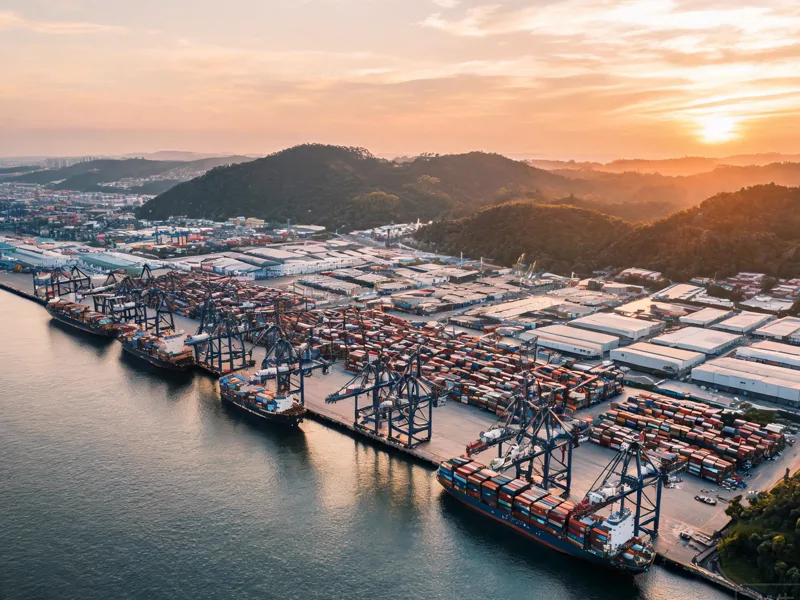
In short: Cross-border e-commerce into Brazil needs four linked stages, not one freight booking: first mile from China, import clearance, warehousing and value-added work in Brazil, and last-mile delivery with a returns path. Baitong Logistics runs this as a single chain — ocean, air and parcel first mile from China, a 20,000 m² warehouse in São Paulo, a 5,000 m² duty-free warehouse in Uruguay, seller-side prep work, last-mile handover and a 7-day no-reason return process for eligible goods.
Most importers can move cargo to Brazil. The difficulty starts after arrival. Clearance rules change, the tax burden is high and layered, delivery coverage is uneven outside major cities, and returns are expensive to handle if you have no local address. A freight-only arrangement leaves the seller to solve the other three stages alone, and that is usually where margin disappears.
The practical answer is to treat Brazil as one chain with four handoffs, and to have one party accountable for all four.
| Mode | Best for | Indicative transit | Notes |
|---|---|---|---|
| Air freight | Fast-moving SKUs, launches, replenishment | 3–10 days door-to-door | Guarulhos (GRU) is the main gateway |
| Ocean FCL | Bulk replenishment, furniture, large goods | 35–45 days port-to-port | Santos and Paranaguá are the main ports |
| Ocean LCL | Mid-volume, mixed SKUs | 40–50 days door-to-door | Consolidated; pay for space used |
| Cross-border parcels | Direct-to-consumer small items | Varies widely by clearance model | Transit predictability depends on the postal channel |
Choosing between these is a working-capital decision as much as a logistics one: air costs more per kilogram but shortens the cash conversion cycle and reduces stockout risk on best sellers.
Brazil is not a single-rate market. The applicable regime depends on the seller model, the value band of the shipment and whether goods enter through a duty-free zone or a conventional import. The two models importers most often compare are:
Getting this wrong is the most expensive mistake in the Brazil chain. It is worth confirming the regime in writing for your product and price band before booking freight.
Our Brazilian footprint is built for sellers who need local inventory without building their own operation.
| Facility | Location | Size | What it is used for |
|---|---|---|---|
| Distribution warehouse | São Paulo | 20,000 m² | Storage, order fulfilment, labelling, returns processing |
| Duty-free warehouse | Uruguay | 5,000 m² | Regional stock holding and staged release into Brazil |
Typical value-added work handled in the warehouse:
Last-mile handover uses domestic carriers appropriate to the destination region; delivery performance in the major Southeast region is materially better than in remote northern states, and transit quotes should reflect that rather than promising a single national number.
Returns are handled through the same warehouse: the customer returns to a Brazilian address, the item is inspected, and it is either restocked, repaired, or written off with photo evidence. Eligible items can be offered with a 7-day no-reason return policy, which is a meaningful conversion lever in a market where buyers actively check return terms.
| Stage | Baitong capability | What you get |
|---|---|---|
| 1. China first mile | Ocean FCL/LCL, air, parcels; 10 warehouses and CFS in China including Dongguan | Factory pickup, export clearance, consolidation |
| 2. Clearance | Import declaration support and DDP options | Tax and duty handled inside one commercial quote |
| 3. Brazil warehousing | 20,000 m² São Paulo + 5,000 m² Uruguay duty-free | Local inventory, prep work, fulfilment |
| 4. Last mile | Domestic carrier handover | Delivery to end customer with tracking |
| 5. Returns | Returns desk inside the warehouse | Inspection, grading, restock, 7-day no-reason policy for eligible goods |
Send your product category, expected monthly volume, price band and target delivery promise to overseas02@batongls.com or WhatsApp +86 191 2930 8513. We will propose a first-mile mode, a clearance model and a warehousing plan as one document.
Related reading: shipping from China to Brazil, South America routes, warehousing and consolidation.
Yes. Baitong operates a 20,000 m² distribution warehouse in São Paulo and a 5,000 m² duty-free warehouse in Uruguay for regional stock holding and staged release into Brazil.
Yes. The chain covers China pickup and export clearance, ocean or air carriage, import clearance support, warehousing and value-added work in Brazil, last-mile handover and returns processing.
Indicative times are 3–10 days door-to-door by air and 35–45 days port-to-port by ocean FCL, with LCL typically 40–50 days door-to-door. Clearance regime and destination region are the main variables.
Eligible goods handled through the São Paulo warehouse can be offered with a 7-day no-reason return policy, with returns received, inspected and restocked locally.
Dec 15,2025
If you're a newly established company in the UAE planning to import goods from China and wants to know what are the best products imported to UAE from China. We will share with you the infomation you need step-by-step. China as the factory of th
Jan 02,2025
With global trade continuously growing, more and more companies in UAE are buying and shipping products from China to the UAE. Particularly in sectors like electronics, machinery, and fashion. And selecting the right shipping method
May 30,2024
Whether you're a small business or a multinational corporation, the efficiency and reliability of your supply chain depend greatly on the expertise and capabilities of your chosen freight forwarder.





 Email:


