
Door-to-Door Shipping From China To The World
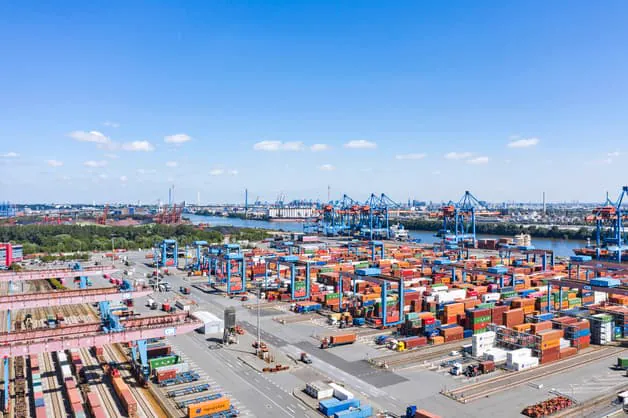
Quayside container handling was off 6.6% to 2.2M TEU; container hinterland transport services remained comparatively stable, while there was a marked drop in demand for transhipment
The slackening of import and export flows is put down to coronavirus impacts. “The partial shutdown of the Chinese economy, resulting in blank sailings in shipping, led to lower cargo handling in Hamburg,” explained Axel Mattern, Joint CEO of Port of Hamburg Marketing.
The China effect is particularly important for Hamburg, as China is the port’s most important trading partner by volume on seaborne container traffic. At 579,400 TEU, the total number of containers handled during Q1 in Hamburg o/d China, was down by 14.6%.
The USA is in second place and in Q1 that business was up 20.7% in Q1 to 146,100 TEU. partners, in the first quarter the USA accounted for 146,100 TEU. “This strikingly good trend in container services with the USA is attributable to four container services newly started from Hamburg at the beginning of 2019," explained Mattern. "These made excellent progress and ensured larger throughput volumes, above all with US East Coast ports.”
Traffic with the third partner, Singapore, was up by 10.5% to 111,000 TEU. Mattern attributes this increase to the transfer of transhipment services from other Asian countries to Singapore.
In Hamburg, by contrast, the transhipment sector was especially affected by the corona crisis with a decline of 10.8% to 772,000 TEU. Seaport-hinterland container services by rail, truck and inland waterway craft proved more stable in Q1, volume being just 4% lower at 1.4M TEU. Of such significance for the Port of Hamburg, railborne freight transport, down 4.3% at 11.9 Mt, or 4.6% at 663,000 TEU, on Q1 2019, was still at a considerably higher level than the 612,000 TEU than in Q1 2018.
“In recent weeks the Port of Hamburg’s superb hinterland connection has played a major part in ensuring that even in difficult times its effectiveness has remained unimpaired,” said Jens Meier, CEO of HPA. “Despite temporarily lower container volumes caused by the corona crisis, in the first quarter the port railway was able to report stable utilization and indeed even to improve on the 2018 level. That was by no means to be taken for granted, but is the result of systematically boosting efficiency and continuously expanding the Hamburg Port Railway.”
Q1 throughput of bulk cargoes was 11.9% lower at 9.4 Mt. In this throughput segment, exports performed well, being 11.9% higher at 2.7 Mt. The trend was sustained by notable increases in exports of grain, up 177.2% at 694,000 tons, and of fertilizers, 8.1% higher at 638,000 tons.
For the next few months, Axel Mattern assumes that the Hamburg must initially adapt to a continuation of blank sailings and falling total throughput, but he is upbeat. “From June, it is entirely possible that with a gradual pick-up in the economy in China and Europe, we will see an increase in sailings and rising volumes on port throughput and seaport-hinterland services.”

Dec 15,2025
If you're a newly established company in the UAE planning to import goods from China and wants to know what are the best products imported to UAE from China. We will share with you the infomation you need step-by-step. China as the factory of th
Jan 02,2025
With global trade continuously growing, more and more companies in UAE are buying and shipping products from China to the UAE. Particularly in sectors like electronics, machinery, and fashion. And selecting the right shipping method
May 30,2024
Whether you're a small business or a multinational corporation, the efficiency and reliability of your supply chain depend greatly on the expertise and capabilities of your chosen freight forwarder.









 Email:


