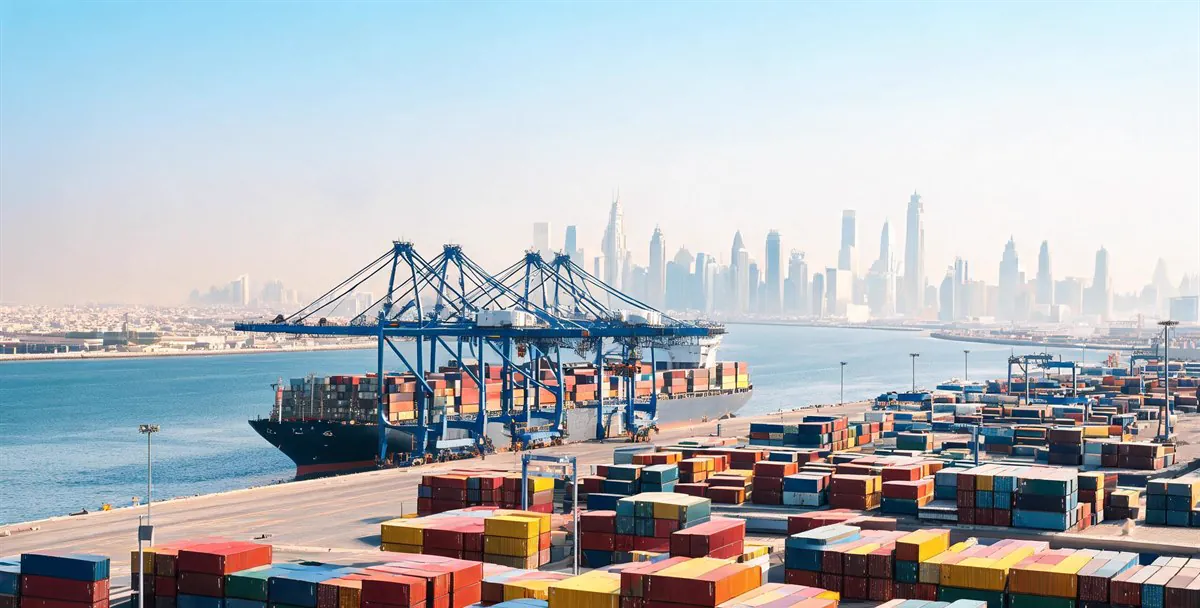
Direct answer: For sea freight from China to the UAE (typically Jebel Ali / Dubai), the core required documents are the Bill of Lading (or Sea Waybill), Commercial Invoice, Packing List, and an Origin document (often a Certificate of Origin for preferential duty). Conditional documents depend on the goods: an Attestation/legalization for some invoices, SASO-type certificates only for certain regulated products, halal certificates for specific food/cosmetic lines, and SABER only when transshipped or for Saudi-bound cargo. The most common delay is a mismatched invoice/PO/packing list or a BL that doesn't match the consignee. Get the set right before departure.
By the UAE Clearance Operations team, Baton Logistics — we clear China-origin sea freight into Jebel Ali routinely, and nine out of ten delays are paperwork, not the boat.
Verify the "conditional" column with your clearance team — UAE rules vary by emirate, free zone, and product. This list reflects common practice, not a guarantee.
| Document | Issued by | Required? | Common error |
|---|---|---|---|
| Bill of Lading / Sea Waybill | Carrier / forwarder | Required | Consignee name mismatch; late telex release |
| Commercial Invoice | Exporter (supplier) | Required | Value/HS code mismatch with packing list |
| Packing List | Exporter | Required | Carton count differs from BL |
| Certificate of Origin | Chamber / issuer | Usually required for duty | Not legalized where needed |
| Attested Invoice | UAE embassy/notary (conditional) | Conditional | Skipped for regulated goods |
| HS Code declaration | Importer / broker | Required | Wrong classification → duty dispute |
| Product certificates (halal, SASO, etc.) | Relevant authority | Conditional by product | Missing for regulated lines |
| SABER / SASO | SABER platform | Only if Saudi-bound/transship | Applied where not needed |
Choose based on whether you need to transfer title or change consignee mid-transit. For most UAE importers wanting speed, an approved telex release on a straight B/L is common.
Baton's Customs Clearance team pre-checks UAE documentation before the vessel arrives.
Q: What documents do I need to import sea freight from China to Dubai?
A: At minimum: Bill of Lading or Sea Waybill, Commercial Invoice, Packing List, and an Origin document (often a Certificate of Origin). Additional certificates are conditional on the product.
Q: Bill of lading vs sea waybill for UAE imports — which?
A: A B/L is a document of title needing original(s) or a telex release; a Sea Waybill releases on consignee identity with no original. Pick B/L if you may transfer title; Sea Waybill for speed.
Q: Is SABER required for imports into the UAE?
A: No — SABER/SASO is Saudi Arabia's system. It applies only if your cargo is Saudi-bound or transshipping through the UAE to Saudi. Don't apply it to standard UAE imports.
Q: Why is my UAE shipment delayed at customs?
A: Most often a mismatch between invoice, packing list, and BL, or a missing/wrong HS code or certificate for a regulated product.
This article is part of our topic clusters on Baton Logistics:
Mar 09,2022
At the beginning of the new year, the most frequently asked question after work is about RCEP. I really want to write an article to introduce it to you, but my ability is limited, and the scope of RCEP is too large. I can only answer some of the most freq
Mar 09,2022
Yes, our service cover all major ports in China areas , like Shanghai / Qingdao / Ningbo/Shenzhen/Guangzhou/Hong Kong etc, Our warehouse facility in these ports are more than 5,000 square meter.
Mar 09,2022







 Email:


