
Door-to-Door Shipping From China To The World
The port professional company has inspected the box, and there is no problem.The weather during the transportation is warm and sunny, dry and not humid;Strictly inspect the goods when they are packed without moisture.Why is it that when the goods arrived at the port of destination, the sides of the boxes were all beads of water. The packaging was wet and the goods were rusted. Who is responsible for the heavy losses?
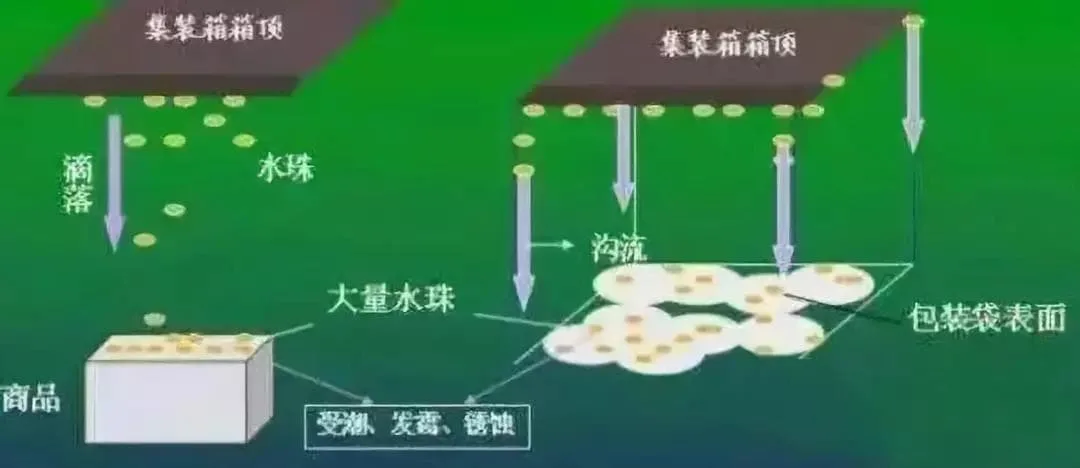
The cause of the water
The water content of the container depends on the weather, the length of the sea voyage, the material used to pack the goods, the condition of the container and the sensitivity of the goods.Fungi, molds and mildew will damage the goods when the relative humidity exceeds 55%.
There is water in the container, which can be divided into the following situations: the goods brought with them, the container condensation, sea water immersion, fresh water immersion
1. Bring the goods with you
Moisture or moisture is brought into the container with the goods.For example, if a container contains 5 tons of furniture, the furniture itself will contain about 8 to 25 percent humidity, depending on the type of wood and the degree of drying.That's equivalent to about 400 to 1,250 liters of water.Some of this moisture is released into the air inside the container, becoming an important source of container condensation.
2, box condensation
In the process of ocean shipping or storage, containers often experience high temperature climate and strong day-night temperature difference. The temperature change will be between 0 ℃ and 8 ℃, and the humidity will be as high as 98%, which is the phenomenon of condensation. When the temperature is 30 ℃, the water content in the air is 30.4g per square meter.When the temperature drops from 30 degrees Celsius to 18 degrees Celsius, the water vapor condenses into water droplets. A 40-foot container can produce 1,000 grams of condensed water, creating "container rain."
3. Sea water immersion
How can you not wet the tank when you are always floating on the sea?If there is a big storm, if there is a small damage to the box, if you are on deck, or if you are in a maritime accident and fall into the sea, you will not escape into the sea or wet.I won't go into that.
4. Fresh water immersion
If the roof of the box or the side board, the front board, the door board and the door rubber strip are damaged, the water will enter the water when it rains or snows or the ship's fresh water pipeline breaks.In the near future, typhoon intensive, the north and south of the strong wind and rain, shipping to prevent the problem of water.
Insurance corresponding
Fresh water deluge insurance: one of the general additional risks, which is responsible for the compensation for the loss caused by fresh water (including drinking water on board, leaking pipes, dripping poles, etc.), rain water and snow dissolved water.
Risk of moisture and heat: the insured goods shall be liable for the losses caused by condensation, dampness or fever of water vapor in the cabin due to sudden change of temperature or failure of ventilation equipment on board during the transportation.
W.P.A. also known as particular average, is one of the basic risks of Marine cargoes. It covers damage caused by salt water only, and not by fresh water.
preventive measure
1. Moisture and water damage can be prevented.
2. Check whether the container is sealed and dry before packing;
3. Confirm whether the goods and loading environment are dry;
4. Strengthen the waterproof packaging of goods;
5. Properly place the desiccant in the box;
6. Visually track the goods throughout the whole process.
7. All links of cargo transportation need to be controlled in real time, and the whole process should be visualized as far as possible. All kinds of documents should be kept for proof in case of emergency.
Dec 15,2025
If you're a newly established company in the UAE planning to import goods from China and wants to know what are the best products imported to UAE from China. We will share with you the infomation you need step-by-step. China as the factory of th
Jan 02,2025
With global trade continuously growing, more and more companies in UAE are buying and shipping products from China to the UAE. Particularly in sectors like electronics, machinery, and fashion. And selecting the right shipping method
May 30,2024
Whether you're a small business or a multinational corporation, the efficiency and reliability of your supply chain depend greatly on the expertise and capabilities of your chosen freight forwarder.









 Email:


