
Door-to-Door Shipping From China To The World
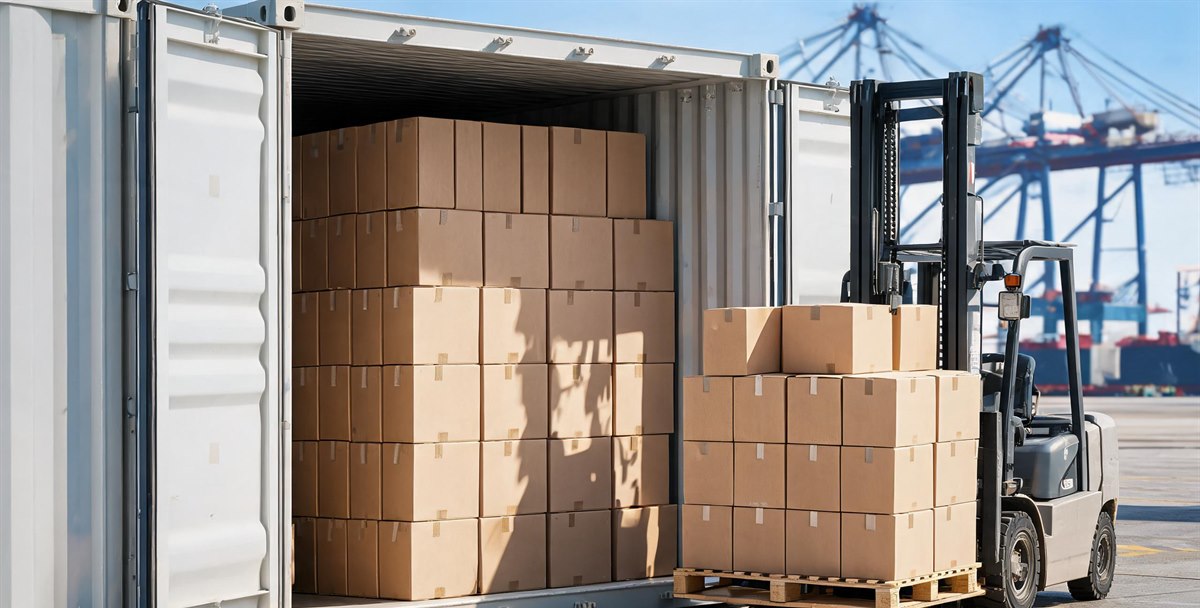
Direct Answer Capsule: Ocean freight cost from China is driven by chargeable volume (CBM) for LCL and by container type for FCL. CBM is calculated as length × width × height (in meters) × number of cartons. For LCL, carriers apply a weight-to-volume ratio (typically 1:1,000 kg = 1 CBM, or 1 CBM = 1,000 kg) and charge the greater of actual weight (tons) and volume (CBM). To optimize cost, maximize cube utilization inside a 40HQ (high-cube) container (76.4 CBM / 2,694 cu ft) vs. a 40GP (67.7 CBM) by stacking cartons to fill vertical space and using proper loading patterns.
| Parameter | Formula | Example |
|---|---|---|
| CBM (volume) | L(m) × W(m) × H(m) × qty | 0.5×0.4×0.3×100 = 6.0 CBM |
| Actual weight | Total kg ÷ 1,000 | 4,000 kg = 4.0 tons |
| Chargeable (LCL) | max(CBM, tons) | max(6.0, 4.0) = 6.0 CBM |
| LCL freight | Chargeable CBM × rate/CBM | 6.0 × $35 = $210 |
W/M rule (Weight or Measurement): LCL carriers charge the higher of weight (in tons) or volume (in CBM). The standard ratio is 1 CBM = 1,000 kg for sea freight (varies by carrier and lane).
| Container | Internal L×W×H (m) | Volume (CBM) | Max Payload (kg) | Best For |
|---|---|---|---|---|
| 20GP | 5.90 × 2.35 × 2.39 | ~33.1 | ~28,200 | Heavy cargo, small volumes |
| 40GP | 12.03 × 2.35 × 2.39 | ~67.7 | ~28,800 | Medium volume, heavy cargo |
| 40HQ | 12.03 × 2.35 × 2.69 | ~76.4 | ~30,400 | Light, voluminous cargo (best CBM/$) |
40HQ advantage: A 40HQ adds ~8.7 CBM of vertical space vs. a 40GP for a small premium, making it the most cost-effective choice for cargo that "cubes out" before it "weights out."
Cargo volume < 15 CBM  → LCL (shared container)
Cargo volume 15–25 CBM  → Compare LCL total vs. 20GP rate
Cargo volume > 25 CBM   → FCL usually cheaper (20GP or 40GP)
Cargo volume > 50 CBM   → 40GP; > 65 CBM → 40HQ

Rule of thumb: FCL becomes cheaper than LCL when LCL
total (CBM rate + destination charges) exceeds the
all-in FCL rate for the next container size.
Need help calculating CBM or choosing between LCL and FCL? Send us your carton dimensions and Baton will recommend the most cost-effective loading plan.
Mar 09,2022
At the beginning of the new year, the most frequently asked question after work is about RCEP. I really want to write an article to introduce it to you, but my ability is limited, and the scope of RCEP is too large. I can only answer some of the most freq
Mar 09,2022
Yes, our service cover all major ports in China areas , like Shanghai / Qingdao / Ningbo/Shenzhen/Guangzhou/Hong Kong etc, Our warehouse facility in these ports are more than 5,000 square meter.
Mar 09,2022








 Email:


