
Door-to-Door Shipping From China To The World
With equipment shortages, strong demand and soaring freight rates in Asia and Europe running almost through the Christmases and New Year holidays, freight forwarders and shippers have little chance of seeing market conditions ease before the Chinese New Year holiday in February.
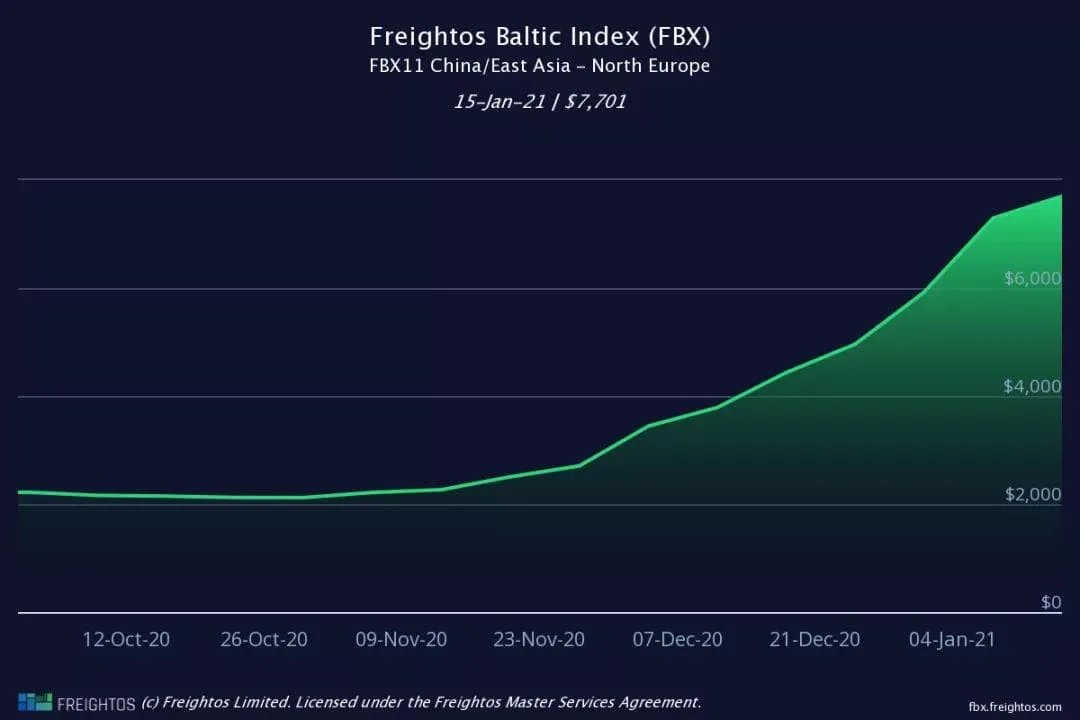
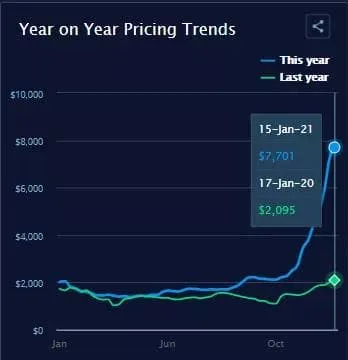
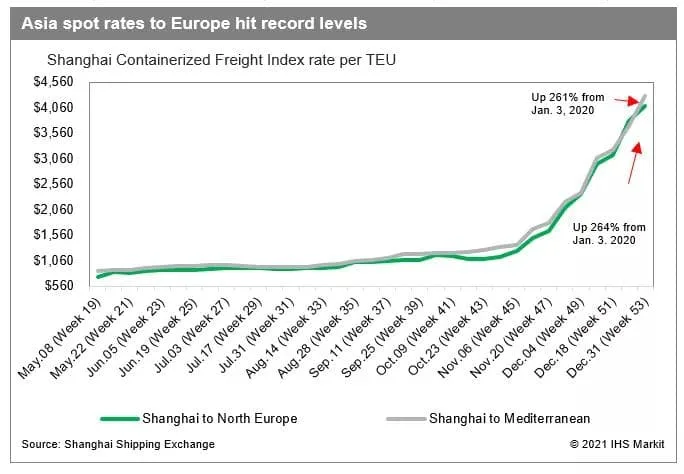
Spot prices from China to northern Europe hit a mind-boggling $7,701 per TEU on January 15, up 268 per cent year on year, according to the Baltic Daily Freight Index (FBX).
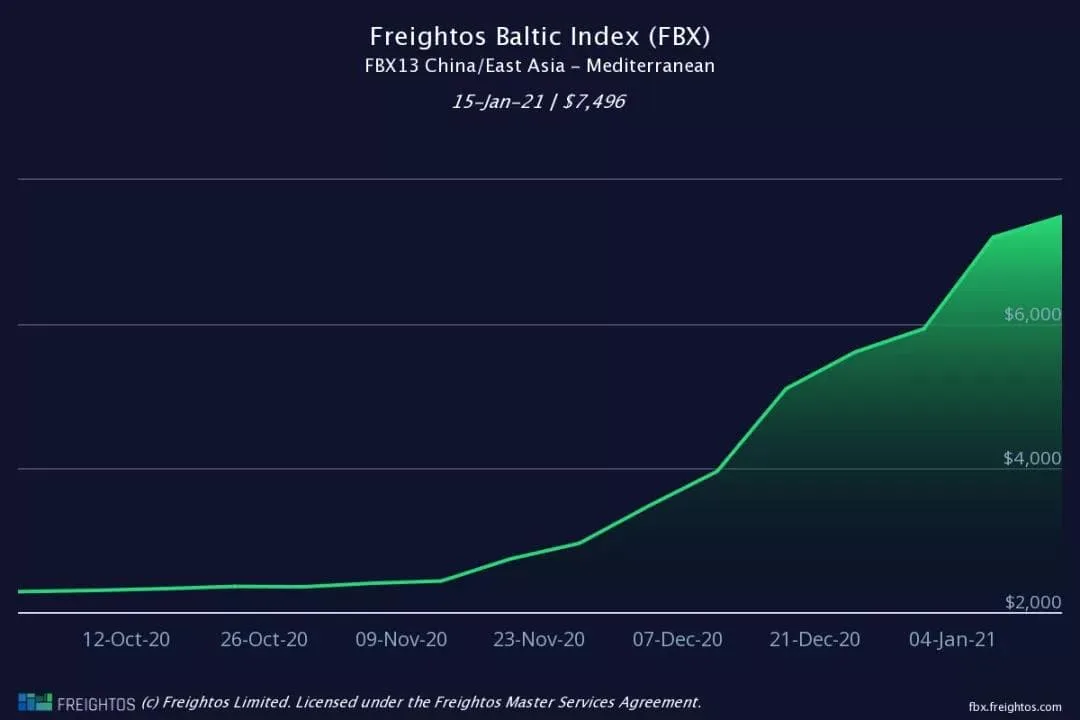
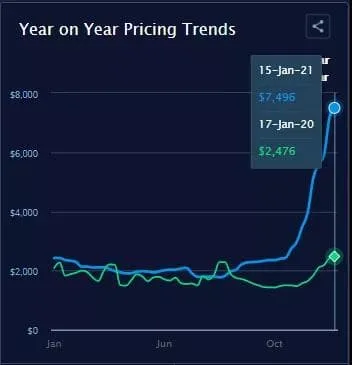
Freightrates from China to the Mediterranean follow a similar curve, rising 203 per cent from a year ago at $7,496.
Spot freight rates in Asia and Europe have risen almost vertically since the end of October 2020, from $1,164 per TEU to $4,191 on January 2, 2021, according to data from Xeneta, an internationally renowned freight benchmark and market analysis platform.
These indices reflect the total rates paid for trade, and shippers are reporting back to forwarders who are giving them eye-opening rates to Asia and Europe. A shipper told reporters that a freight company last week quoted rates of $13, 000 to $16, 000 per FEU valid for one week Asia-Northern Europe.
"I know that capacity on this route may be more tight than on other routes, but these prices are still crazy," the shipper said.
Factories are usually closed for up to three weeks around the start of China's Lunar New Year celebrations, which begin on Feb. 12.
But so far this year, there have been mixed reports from Chinese manufacturers that some will cancel holidays to cope with backlogs of orders, while others will close for longer.
This uncertainty makes capacity management more difficult for carriers.
Carriers have so far announced only seven cancellations on Asia-Europe routes during the three-week Chinese New Year holiday, which begins at the end of January, Sea Intelligence said in a recent newsletter.
Shipowners have announced a total reduction of 6-13 per cent of capacity, compared with 40 per cent in January last year.
The newsletter noted that shipowners usually announce cancellations six to eight weeks before the Spring Festival, putting pressure on people to "run out of time."
However, there may be other reasons behind the shipowners' reticence.
A Maersk spokesman said that while the outlook for demand this year remained limited, the current pattern of cargo buying and supply problems with container equipment and vessels were only temporary.
Maersk expects demand to "normalise" in the first half of the year and plans to cut back on trips around the Chinese New Year to rebalance container traffic.
The spokesman said stocks in the U.S. and European markets have been largely replenished, and the launch of the vaccine 'will also alleviate the situation.'
There is no sign yet of weakening demand
But apparently not everyone agrees with Maersk.
Dominique von Orelli, executive vice-president and head of global Marine freight at DHL Global Forwarding, said continued strong demand would keep container rates high in the first quarter of this year.
"This very strong demand momentum" shows no sign of abating, he said.
"There will probably be a slight drop in freight rates during the Spring Festival period, but the overall momentum should continue through March and even into the second quarter," von O 'Reilly said. He added that any shipments beyond the agreed minimum quantity commitments (MQCs) would lead to price increases.
"Now if you go to a retail store in Germany and want to buy a blazer, or you go to Ikea and you buy a bed, or you go to a furniture store and you buy a chair, they will give you 12 weeks or more of lead time because the stock has been cleared." "Most companies are trying to replenish their inventories, but at the same time, strong demand has not abated, so it's still hard to get inventory up to what customers want," the source added. "It will take some time to get into balance, so we don't expect demand to stabilize until March or April."
Herberot CEO Rolf Habben Jansen took a similar view, saying in his latest market report in late December that "two months ago, I said [high] demand would continue until the Chinese New Year and then volumes would decline."
He added: "Today, I have to be honest and say that we are likely to continue to deal with very high traffic volumes for some time to come.
After all, the bottleneck that currently fails to ease capacity constraints is not only in logistics, but also in production.
There is still a lot of work to be done.
I'm afraid it will take some time to resolve the bottleneck.
The Chinese New Year gives us a break for two or three weeks.
But not everything is going to be resolved during that time."
Since its peak in the third quarter of 2020, China has faced a severe shortage of empty containers, along with high demand from Asia and Europe.
The European logistics executive said the tight supply of containers would continue into the second quarter.
"The second quarter is expected to see an easing of the epidemic," he said. "By that time there will be more labor available in warehouses and terminals in Europe and other destinations, which will lead to a faster flow of containers."

Dec 15,2025
If you're a newly established company in the UAE planning to import goods from China and wants to know what are the best products imported to UAE from China. We will share with you the infomation you need step-by-step. China as the factory of th
Jan 02,2025
With global trade continuously growing, more and more companies in UAE are buying and shipping products from China to the UAE. Particularly in sectors like electronics, machinery, and fashion. And selecting the right shipping method
May 30,2024
Whether you're a small business or a multinational corporation, the efficiency and reliability of your supply chain depend greatly on the expertise and capabilities of your chosen freight forwarder.









 Email:


