
Door-to-Door Shipping From China To The World
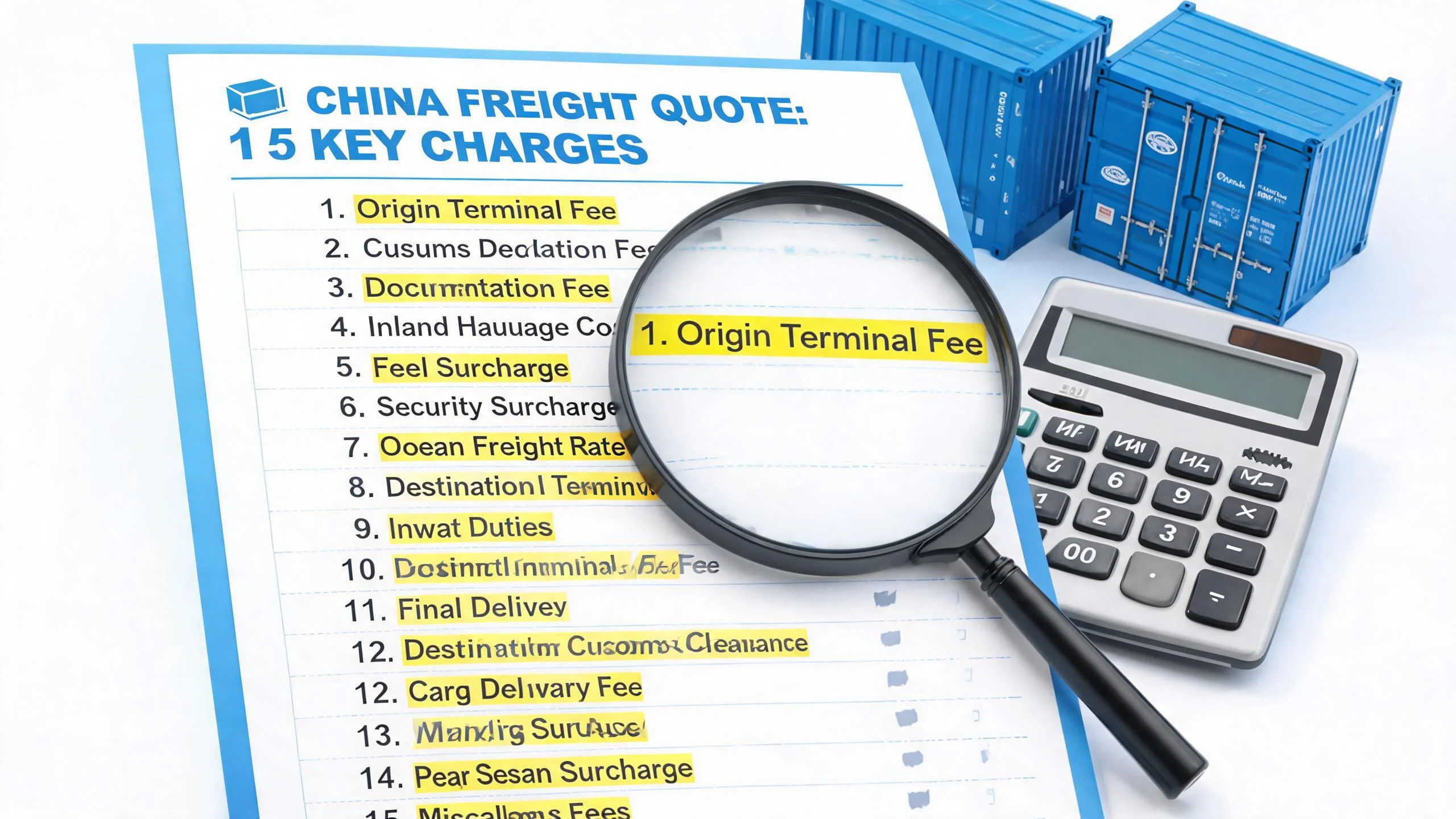
Quick answer: Landed cost is not the FOB price, and it is not the freight quote. It is the total you pay to get goods from a Chinese factory to a usable position at destination — goods value, international freight, insurance, customs duties, import taxes, trade-remedy measures, clearance and port charges, and last-mile delivery. A workable formula is:
> Landed cost = goods value + freight + insurance + customs duties + import taxes + clearance & destination charges + last-mile delivery + compliance and working-capital buffer
Which party pays each block is set by the Incoterm and the sales contract; which party is legally answerable to the destination authority is set by that authority's rules and the importer of record. Duty and tax rates are determined by the HS classification, origin, destination and the tariff schedule in force on the date of import — not by the forwarder. This guide gives a reusable calculation framework and a destination-by-destination responsibility matrix. It deliberately does not publish rate tables or threshold amounts: those change frequently, and quoting an outdated number is worse than quoting none. Always confirm current rates with the destination customs authority or a licensed broker.
Most "my shipment cost more than expected" disputes come from a missing block, not a wrong rate.
| # | Cost block | Who typically supplies the number | Included in a DDP quote? | Commonly missed |
|---|---|---|---|---|
| 1 | Goods value (ex-works / FOB) | Supplier's commercial invoice | Yes, usually | Incoterm not stated on the invoice |
| 2 | Origin charges, export clearance, trucking | China forwarder | Yes | Origin terminal and documentation fees |
| 3 | Main-leg freight (ocean / air / rail / courier) | Carrier / forwarder | Yes | Season surcharges, rate validity windows |
| 4 | Marine / air cargo insurance | Insurer / forwarder | Sometimes | Insured value basis and deductibles |
| 5 | Customs duties | Destination tariff by HS code | Yes, if DDP | Trade-remedy duties on top of the base tariff |
| 6 | Import taxes (VAT / GST / consumption tax etc.) | Destination tax rules | Yes, if DDP, but check the mechanism | Whether tax is deferred, reclaimed or prepaid |
| 7 | Customs clearance, broker, port and terminal charges | Destination broker / carrier | Yes, if DDP | Examination, storage and amendment fees |
| 8 | Last-mile delivery, appointment, unloading | Destination carrier | Yes, if door-to-door | Residential delivery, liftgate, appointment windows |
| 9 | Compliance & documentation (CO, certifications, legalisation) | Exporter / chamber / agent | Often excluded | Product-specific conformity schemes |
| 10 | Working-capital buffer (cash tied up in duty/VAT, FX, delays) | Importer | No | Especially material under DDP vs DAP cash flow |
Two practical notes. First, a cheap headline freight rate is not a cheap landed cost — see the line-by-line breakdown in Read a China Freight Quote: 15 Charges Importers Must Check and Why Your Freight Quote and Final Invoice Don't Match. Second, rate benchmarks such as those in China to USA Shipping Cost 2026 describe the freight block; they are not a tax estimate.
Work in order. Each step produces an input for the next one.
| Step | Input you need | Output | Source of truth |
|---|---|---|---|
| 1 | Product description, material, use, HS/HTS code | Classification | Destination tariff database / licensed broker |
| 2 | Commercial invoice value, Incoterm, freight, insurance, assists, royalties | Customs value in the destination's required basis | Invoice + contract + destination valuation rules |
| 3 | Customs value × applicable duty rate(s) | Base duty | Current tariff schedule |
| 4 | Product + origin check against remedy lists | Additional / anti-dumping / countervailing duty, if applicable | Current trade-remedy notices |
| 5 | Customs value + duty (+ certain other additions) × import tax rate | Import VAT / GST / equivalent | Current tax rules; check deferment or reclaim eligibility |
| 6 | Broker, port, terminal, examination, delivery | Destination charges | Broker / carrier tariff |
| 7 | Sum of blocks 1–9, plus buffer | Landed cost per unit | Your worksheet |
Worked example (illustrative only — the numbers below are invented to show the arithmetic, not to represent any real rate or quote). Assume a buyer is quoted FOB Shenzhen USD 10,000 for one consignment; ocean freight and insurance USD 1,500; the destination's customs value is built on a CIF-type basis; the applicable duty rate is assumed at 5%; import tax at 10% applied to customs value plus duty; and destination clearance plus delivery at USD 800.
| Line | Calculation (illustrative) | Amount (USD) |
|---|---|---|
| Goods value (FOB) | — | 10,000 |
| Freight + insurance | — | 1,500 |
| Customs value | 10,000 + 1,500 | 11,500 |
| Customs duty | 11,500 × 5% | 575 |
| Import tax base | 11,500 + 575 | 12,075 |
| Import tax | 12,075 × 10% | 1,207.50 |
| Clearance + delivery | — | 800 |
| Landed cost | sum | 14,082.50 |
What this example shows: the FOB price is roughly 71% of the final figure, and the tax is calculated on a base that already includes duty. Neither effect is visible if you only look at the freight quote. Do not reuse the 5% / 10% figures — they are placeholders. Replace every rate and every valuation rule with the current published rules for your HS code and destination.
The structure of the calculation is stable; the content of each line is not. This matrix describes which questions to ask per destination — it is a planning map, not a rate table.
| Destination | Typical tax/duty structure to check | Registration / filing party to confirm | Deep dive on this site |
|---|---|---|---|
| United States | Customs duty by HTSUS; possible additional measures on China-origin goods; merchandise/harbour-type fees; no federal import VAT (state sales/use tax is a separate matter) | Importer of record, customs bond, broker; advance filing separate from clearance | US Import Customs Clearance: Section 301, HTS & Bonds |
| European Union | Customs duty by TARIC/CN code + import VAT; possible anti-dumping measures | EORI, importer/VAT registration; VAT deferment or postponed accounting where available | DDP to Europe: EORI, Import VAT Deferment & PVA |
| United Kingdom | Customs duty + import VAT; VAT accounting mechanisms | VAT registration, EORI, importer of record | Common Incoterms Explained |
| Canada | Customs duty + GST/HST; CBSA advance data | Importer / broker; advance commercial information | Door-to-Door DDP Shipping from China |
| Australia | Customs duty by HS + GST on taxable import value; biosecurity and treatment rules for wood/plant materials | Importer, ABF/DAFF requirements | Shipping China to Australia: Duties, Biosecurity & Freight Planning |
| Japan | Customs duty + consumption tax (JCT); ACP/IOR structures for cross-border e-commerce | ACP (attorney for customs procedures) vs IOR | China to Japan: ACP vs IOR & JCT Compliance |
| Middle East (e.g. Saudi Arabia, UAE) | Customs duty + VAT where applicable; product conformity schemes (SASO/SABER); country-specific document rules | Local importer / registration, platform-based pre-registration in some markets | China to Middle East DDP: SASO, SABER & UAE Customs |
How to read this table: the third column is where most DDP shipments fail. A forwarder can arrange transport and pay charges, but the destination authority needs a valid registered party, a valid classification, and (in some markets) a pre-registration or conformity certificate. Confirm those before the booking, in the same way you would confirm origin-side declarations and documentation — see Why Shipments Get Held at China Customs for the origin compliance checks that belong before loading.
| Trade term | Who arranges main carriage | Who normally pays duties & import taxes | Who is the importer of record | Common misunderstanding |
|---|---|---|---|---|
| EXW / FCA / FOB | Buyer | Buyer | Buyer / its broker | "FOB means the seller handles export clearance" — check the term's exact obligations |
| CIF / CFR / CIP | Seller (contracts carriage) | Buyer at destination | Buyer / its broker | "CIF includes insurance and freight, so it includes duty" — it does not |
| DAP / DDU | Seller to named place | Buyer (unless contract says otherwise) | Buyer / its broker | "DDP and DAP are the same" — they are not |
| DDP | Seller to destination, door-to-door | Seller arranges and pays | Still a registered importer at destination (often the seller's structure or the buyer, per contract) | "DDP means the buyer has no compliance role at all" |
The distinction matters for two reasons. First, Incoterms® 2020 allocate costs and risks between commercial parties; they do not, on their own, alter statutory liability to a customs or tax authority. Second, under DDP the seller needs a compliant destination setup (registration, VAT handling, valuation, classification). If that setup is weak, the "all-in" price is not reliable. Put the allocation of duties, taxes, VAT recovery, classification decisions and amendment costs in writing into the sales contract and the forwarder's service agreement. See DDP vs DDU vs DAP, Common Incoterms Explained and the International Trade Terms topic page.
Whether a small consignment is dutiable or taxable depends on a set of destination-specific rules that have been reformed repeatedly in recent years. Treat this as a current-rules question with four parts:
Two cautions. Do not structure or split shipments primarily to stay under a threshold — anti-avoidance rules and carrier/customs data matching make that a compliance exposure, not a saving. And do not assume a sample is duty-free: samples with commercial value, or samples of products subject to conformity or trade-remedy measures, can still attract duty, tax and documentation requirements. Confirm the current rules with the destination authority or a licensed broker before shipping.
Scenario 1 — First-time importer, FOB quote, wants a door price. The buyer has an FOB number and asks "what will it cost delivered, duties paid?". The forwarder cannot answer from the freight rate alone: it needs the HS code, origin, commercial invoice value, destination, delivery postcode, and the importer/VAT registration position. Once those are supplied, the worksheet in Section 2 produces a DDP number with explicit assumptions. If the buyer cannot supply an importer of record, the quote should say so rather than silently assuming one.
Scenario 2 — Mixed container from several suppliers. A consolidation of products from multiple factories means multiple HS codes, multiple origins of data, and possibly multiple remedy exposures. One "average duty rate" is wrong. Build the landed cost per product line, then add shared freight and clearance charges allocated by volume or value. Consolidation workflows are covered in Ship from Multiple China Suppliers to One Amazon FBA Warehouse.
Scenario 3 — Product subject to trade remedies. For product-and-origin combinations where anti-dumping or countervailing measures apply, the duty line is not the standard tariff rate. The mattress sourcing comparison in China vs Europe Mattress Sourcing: Landed Cost, Duty and Anti-Dumping Exposure shows why FOB comparisons collapse once remedy exposure is included. Check current measures per shipment; do not carry a rate over from a previous order.
Scenario 4 — Preferential origin claim. A buyer asks whether a certificate of origin or an RCEP claim reduces duty. It can, but only if the goods satisfy the applicable rules of origin and the destination accepts the documentation. Origin claims change the input to step 3 in the framework; they do not remove the need for correct classification and valuation. See RCEP Tariff Preferences for Exporters.
Q: 1. What is landed cost?
The total cost of getting goods from the supplier to a usable position at destination: goods value, freight, insurance, duties, import taxes, clearance and port charges, and last-mile delivery — plus a buffer for compliance and working capital.
Q: 2. How do I calculate import duty on goods from China?
Establish the HS classification, determine the customs value in the destination's required basis, then apply the current duty rate and any applicable trade-remedy measures. The rate comes from the destination tariff schedule, not from the supplier or the forwarder.
Q: 3. Does a DDP freight quote include import VAT and customs duties?
A properly scoped DDP quote should, but check the line items and the contract. Some quotes cover duty but handle import VAT through a deferment or postponement mechanism, which changes cash flow rather than the headline price. See DDP to Europe: EORI, Import VAT Deferment & PVA.
Q: 4. Who is legally responsible for import duties under DDP?
The commercial allocation says the seller arranges and pays. The destination authority still requires a valid importer of record and looks to that party under its own rules. Put the allocation in writing; do not assume the trade term settles it.
Q: 5. Is customs duty calculated on FOB or CIF value?
It depends on the destination's valuation rules. Many use a CIF-type basis (invoice value plus freight and insurance and specified additions); others use a different base. Confirm before calculating — the base affects both duty and import tax.
Q: 6. What is de minimis, and does it apply to China shipments?
A threshold below which certain duties or taxes may be relieved for qualifying low-value consignments. Whether it exists, what it covers and how it is calculated are destination-specific and have changed significantly in several markets. Verify current rules; do not rely on a figure quoted in an older guide.
Q: 7. Are samples from China duty-free?
Not automatically. Samples with commercial value, or samples of regulated products, can still attract duty, tax and conformity documentation. Declare them accurately rather than assuming relief.
Q: 8. Can I reduce duty by splitting a shipment into smaller parcels?
Do not plan around thresholds to avoid duty. Anti-avoidance rules and data matching make splitting a compliance exposure. Discuss legitimate, documented structures with a licensed broker instead.
Q: 9. How does HS classification affect my final bill?
It determines the duty rate, whether trade-remedy measures apply, and often the import tax treatment and documentation requirements. A misclassification can also trigger a hold or a post-clearance adjustment — see Why Shipments Get Held at China Customs.
Q: 10. What are anti-dumping or countervailing duties?
Additional duties applied to specific product-and-origin combinations following a trade-remedy investigation. They sit on top of the ordinary tariff and change over time. Check the current measures for your product and origin before finalising a landed-cost estimate.
Q: 11. Does a certificate of origin or an RCEP claim reduce duty?
It can, when the goods meet the applicable rules of origin and the destination accepts the documentation. It changes the rate input in the framework; it does not fix an incorrect classification or valuation.
Q: 12. Why did my final invoice exceed the quoted landed cost?
Common causes: a classification or valuation change, an unbudgeted remedy measure, destination examination or storage, a rate or threshold change, or a charge outside the quote's scope. A worksheet that records who supplied each assumption is the fastest way to locate the difference. See Freight Quote vs Final Invoice.
Q: 13. Do I need an EORI, IOR, ACP or VAT registration before booking?
Often yes for DDP or for e-commerce structures. Registration validity affects both the filing and the tax treatment; resolve it before data is transmitted, not after arrival. See the China to Japan ACP/IOR guide and the Middle East DDP guide.
Q: 14. Can Baton Logistics provide a landed-cost estimate?
Baton can help you assemble the worksheet — mapping the cost blocks, identifying which regime applies to your lane, collecting HS, origin and valuation inputs from your suppliers, and coordinating classification and duty questions with the licensed broker at destination. Baton is a freight forwarder and NVOCC, not a tax adviser or licensed customs broker in every jurisdiction; the binding rate determination always comes from the destination authority.
This guide is a planning framework, not tax, customs, legal or compliance advice. Duty rates, import tax treatments, valuation bases, low-value thresholds, trade-remedy measures and registration requirements change over time and vary by product, origin, destination and declaration route. No specific rate or threshold amount is asserted here; the worked example uses clearly labelled illustrative figures only. Confirm current requirements with the destination customs/tax authority, a licensed customs broker or a qualified tax adviser before booking, declaring or contracting.
Baton Logistics (Shenzhen Baton International Logistics Co., Ltd. / 深圳市佰通国际物流有限公司, 佰通物流) is a Shenzhen-based freight forwarder and NVOCC founded in 2003 — not a freight broker — arranging FCL/LCL ocean freight, air freight, customs brokerage coordination, warehousing and consolidation, Amazon FBA forwarding, cargo insurance and DDP/DAP door-to-door shipping from China to 100+ countries. With 10+ warehouses and CFS facilities and SOP-managed consolidation from 20+ suppliers, our operations team can help you map which duty and tax regime applies to your destination, collect the HS, origin and valuation inputs from each factory before the cut-off, and coordinate the classification and duty questions with the licensed broker at destination.
Contact: overseas02@batongls.com · WhatsApp +86 191 2930 8513 · www.batongls.com

Dec 15,2025
If you're a newly established company in the UAE planning to import goods from China and wants to know what are the best products imported to UAE from China. We will share with you the infomation you need step-by-step. China as the factory of th
Jan 02,2025
With global trade continuously growing, more and more companies in UAE are buying and shipping products from China to the UAE. Particularly in sectors like electronics, machinery, and fashion. And selecting the right shipping method
May 30,2024
Whether you're a small business or a multinational corporation, the efficiency and reliability of your supply chain depend greatly on the expertise and capabilities of your chosen freight forwarder.