Direct Answer# Shipping Oversized Furniture, Gym Equipment and Bathware from China (2026 Practical Guide)
Quick answer: Oversized consumer goods — sofas and cabinets, treadmills and racks, bathtubs and vanities — are usually charged by volume as much as by weight, so your real enemy is empty space, poor crating and an unprepared residential delivery. The practical play is: calculate chargeable volume first, decide LCL versus full container on that basis, crate to protect finishes, confirm the last-mile service level (tail lift, appointment, stairs), and photograph everything before it leaves the factory. This guide covers consumer-size goods. Industrial project cargo on flat racks and open tops is a different discipline (oversized machinery guide).
Key takeaways
- Volume, not just weight, sets the price. Bulky, low-density items often charge by cubic measure — cut carton size and you cut cost.
- LCL is flexible; FCL is efficient. Choose by threshold volume and how much you value control and transit certainty.
- Crating protects the finish, not just the box. Corner protection, braces and moisture barriers matter more than outer carton strength.
- Residential delivery is a service package, not a given. Tail lift, appointment and carry-up must be confirmed and priced separately.
- Damage claims are won or lost on evidence. Pre-shipment photos, packing records and clean delivery receipts form the chain.
- Landed cost, not freight rate, decides the margin. Duty, last mile and claim risk all belong in the model (landed-cost framework).
Why these three categories behave alike
Furniture, gym equipment and bathware look different but share a shipping profile: high volume, moderate-to-heavy weight, damage-prone finishes and a residential or small-business destination.
- Furniture — sofas, beds, cabinets, dining sets: large, often irregular shapes; corners and upholstery mark easily.
- Gym equipment — treadmills, bikes, weight racks: heavy, with a high centre of gravity; tipping and point-load damage are common.
- Bathware — bathtubs, shower enclosures, vanities: brittle surfaces, large flat panels, edged ceramic or stone tops that chip.
All three are usually sold to homes or small commercial sites, where the final leg is a residential delivery with narrow access, no dock and no forklift. That last mile is where many "freight" problems actually occur.
Volumetric weight and how you get charged
Carriers charge on the greater of actual weight and chargeable volume — expressed as W/M (weight or measurement) in ocean LCL and as volumetric weight in air freight. Exact divisors and rules vary by carrier and lane; confirm the current ones with your forwarder (chargeable weight explained).
Illustrative example (not a quote): a crate occupying about 2 m³ and weighing 300 kg. In ocean LCL the charge commonly follows the larger of the two measures — here the 2 m³ measurement typically drives it. In air freight the carrier compares 300 kg actual against a computed volumetric weight and charges the higher. The lesson: reducing carton volume can save more than reducing weight for these goods.
| Factor |
How it is measured |
Practical lever |
| Ocean LCL |
W/M — greater of weight (tonnes) and volume (m³) |
Compact packing, remove dead air, knock down furniture where feasible |
| Ocean FCL |
Per container, subject to weight limits and stowage |
Fill the container efficiently; avoid paying for empty space |
| Air freight |
Greater of actual and volumetric weight |
Watch carton dimensions; bulky light goods get penalised |
| Last mile |
Often by carton size, weight and access conditions |
Pre-assess access; avoid re-delivery fees |
Never guess the CBM. Measure the packed carton or crate, not the bare product, and record it. A few centimetres of extra foam across many cartons becomes a real cost.
LCL versus FCL: a decision table
| Situation |
Better fit |
Why |
| Under roughly a container-load, mixed SKUs |
LCL |
Pay only for space used; consolidate multiple suppliers |
| Enough volume to fill most of a container |
FCL |
Lower cost per unit, fewer handoffs, more control |
| High-value, damage-sensitive finishes |
FCL (or dedicated LCL) |
Fewer touches reduce handling damage risk |
| Urgent, smaller top-up order |
LCL or air |
Speed over space efficiency |
| Several suppliers, one destination |
Consolidated LCL |
One shipment, one document set, simpler receipt |
Thresholds are illustrative and depend on current rates — request both options and compare landed cost, not just the freight line (why quotes differ). Consolidating several suppliers into one shipment is often the cheapest route, but it requires tight cut-off control. For a broader modal comparison on another lane, the US-bound decision matrix uses the same volume-versus-weight logic.
Crating and packing that survives the chain
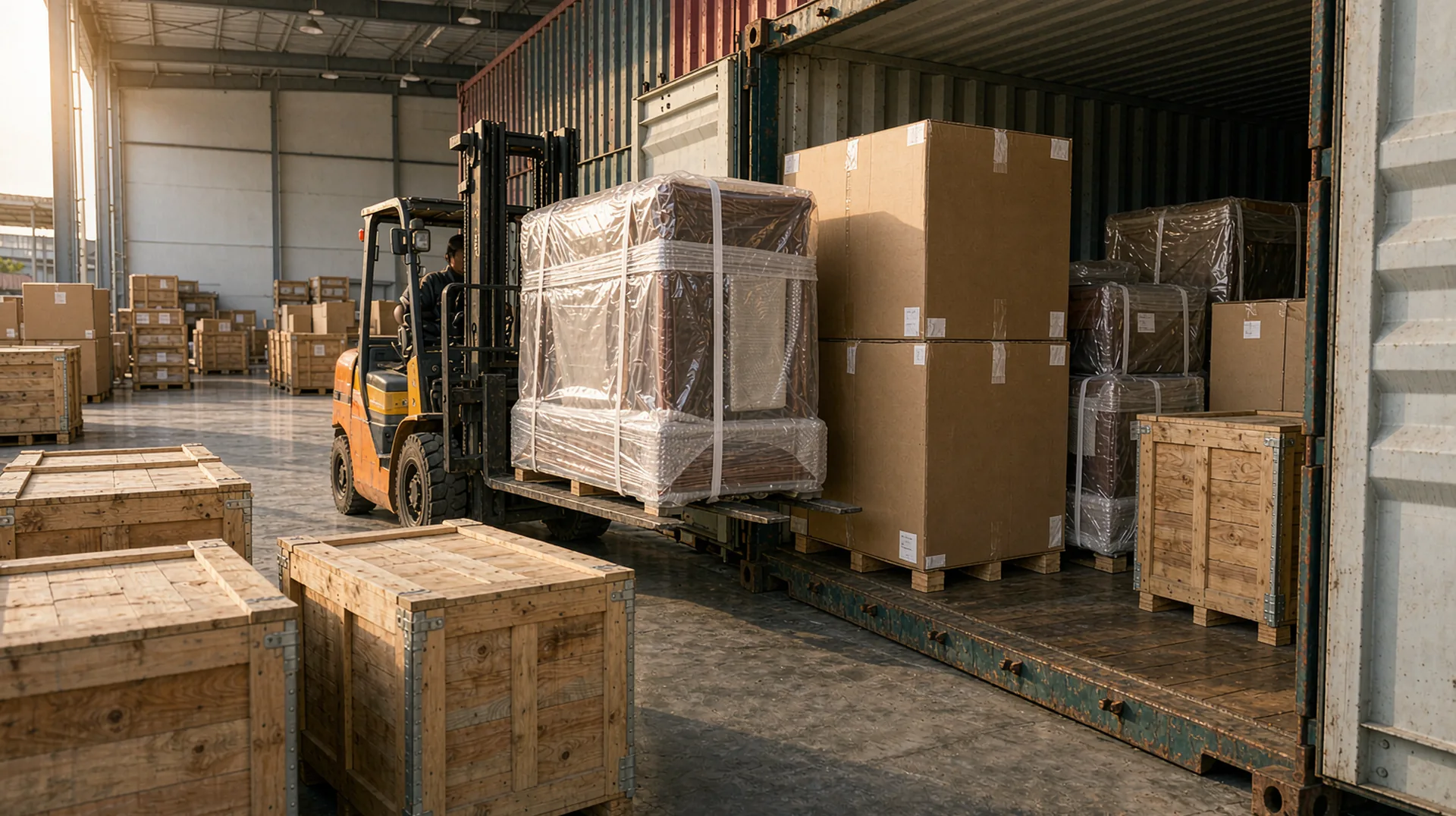
Good packing is about controlling movement and protecting edges, not just adding cardboard.
- Corner and edge protection on every vulnerable point — the most common damage on flat-panel and framed furniture.
- Internal bracing so the contents cannot shift inside the crate; a loose item destroys itself in transit.
- Moisture barrier — especially for upholstered furniture and any sea leg; humidity and condensation are silent damage sources.
- Wooden crates for heavy or fragile pieces. Where wood packaging is used, current destination rules may require treatment and marking (for example ISPM15-type requirements) — confirm with the authority for your market; do not assume.
- Clear external markings — orientation, "fragile," handling icons and a matching packing list with photos.
- Disassembly where practical — knocked-down furniture packs denser and is less likely to break.
Photograph the item before packing, during packing and after sealing. Those images are the foundation of any later claim.
The last mile: tail lift, appointment and carry-up
Residential delivery is where oversized goods most often fail. Confirm each element explicitly, because it is usually not included in a basic freight quote.
| Service element |
What to confirm |
Why it matters |
| Tail lift |
Is a hydraulic lift vehicle provided at delivery? |
Without a dock or forklift, heavy cartons cannot be unloaded |
| Appointment |
Is a delivery window booked and confirmed? |
Unannounced arrival causes failed delivery and re-delivery fees |
| Carry-up / stairs |
Will the carrier carry items inside and up floors? |
Many standard quotes stop at the kerb |
| Access check |
Road width, parking, lift size, doorway clearance |
Oversized cartons can be physically unable to reach the room |
| Debris / assembly |
Is packaging removal or assembly included? |
Usually separate; plan labour locally |
For FBA-bound furniture or bathware, the FC has its own appointment and packaging rules — a separate discipline from home delivery (FBA prep checklist). If goods are later returned, the reverse path is its own cost and process (FBA returns and removals).
Building a damage-claim evidence chain
A claim is only as strong as the paperwork around it. Build the chain at each handoff:
- Pre-shipment photos of the product, finishes and serial numbers.
- Packing record — how it was crated, materials used, photos of the sealed crate.
- Accurate packing list and commercial invoice describing the goods correctly.
- Clean bill of lading / air waybill and any exception notes at receipt.
- Delivery-condition photos taken at the moment of unloading, before signing.
- Immediate written notice to carrier and forwarder, with the evidence attached.
- Independent assessment or repair quote where damage is disputed.
Keep every document in one file per shipment. Late or missing evidence is the usual reason a valid claim fails. Confirm the carrier's claim time limits and procedures at booking — they vary.
Selection checklist
- [ ] Measure packed carton/crate dimensions and calculate chargeable volume.
- [ ] Request both LCL and FCL quotes and compare landed cost.
- [ ] Confirm current carrier weight/volume rules and any surcharges.
- [ ] Specify corner protection, bracing and moisture barrier in packing instructions.
- [ ] Verify wooden packaging treatment/marking requirements for the destination.
- [ ] Confirm tail lift, appointment and carry-up — and their costs — before shipping.
- [ ] Pre-check site access: road, parking, lift, doorway clearance.
- [ ] Photograph before, during and after packing, and at delivery.
- [ ] Decide the Incoterm and who bears damage risk at each handoff (Incoterm choice).
- [ ] Keep a complete per-shipment evidence file and note claim deadlines.
FAQ
Why is my furniture shipped by volume rather than weight?
Because carriers charge the greater of weight and measurement. Bulky, low-density goods generate volume charges that exceed their weight.Is LCL or FCL cheaper for a sofa order?
It depends on volume and current rates. LCL suits smaller, mixed orders; FCL becomes efficient once you fill most of a container. Compare both.How can I reduce shipping cost on oversized goods?
Reduce packed volume: disassemble where possible, remove dead air, use tighter cartons. Volume savings often beat weight savings.Do I need a wooden crate for a bathtub or vanity?
Usually yes for fragile, heavy pieces. Confirm whether destination rules require treatment or marking of wood packaging.What is a tail lift and why does it matter?
A hydraulic vehicle lift that unloads heavy cartons where there is no dock or forklift. Without it, a residential delivery can fail.Is delivery to my door included in the freight quote?
Often not. Unloading, appointment and carry-up are commonly separate. Confirm each in writing.What should I photograph for a damage claim?
The product before packing, the packing process, the sealed crate, and the condition at delivery before signing.When must I report damage?
Immediately, and within the carrier's stated claim window. Confirm time limits at booking; they vary by carrier.Can I ship gym equipment by air?
Sometimes, but chargeable weight makes most large gym equipment expensive by air. Sea is the usual choice; small parts may fly.Is this the same as shipping industrial machinery?
No. Industrial project cargo uses flat racks, open tops and heavy-lift planning — a different service. This guide covers consumer-size goods.
Sources
- Baton Logistics, "Calculate CBM & Chargeable Weight," "Ship Oversized Machinery from China," "Why Freight Forwarder Quotes Differ" — charging basis, cargo categories and cost scope.
- Baton Logistics, "Landed Cost from China Framework," "Door-to-Door DDP from China," "Incoterm Choice," "FBA Prep Checklist," "FBA Returns & Removals" — cost model, responsibility and receiving requirements.
- Relevant national customs authorities and IATA/IMO guidance — current rules on wood packaging, dangerous-goods declarations where applicable, and carrier claim procedures.
This guide is general information, not legal or customs advice. Charging bases, packaging rules and claim procedures change — verify the current official requirements and your carrier's terms. Baton Logistics is an independent China freight forwarder and NVOCC; it is not a licensed customs broker, tax adviser or surety, and nothing here guarantees clearance, delivery or claim settlement.
Get your oversized shipment quoted correctly
Send us the packed dimensions, weight, destination and access conditions, and we will outline the workable LCL/FCL and last-mile options with a clear cost scope. Contact overseas02@batongls.com or WhatsApp +86 191 2930 8513.