
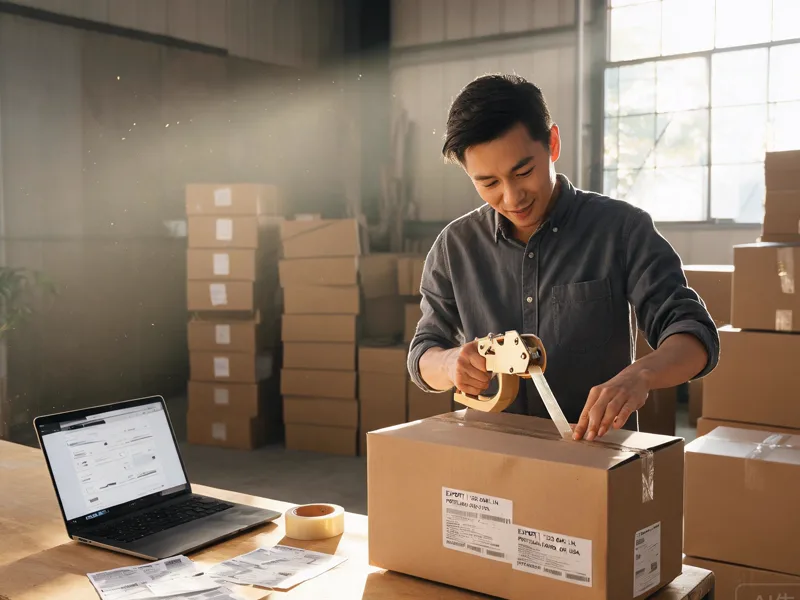
In short: Small businesses can start shipping from China with Baitong Logistics without a large minimum order quantity, because LCL consolidation lets you share a container instead of booking a full one. Your first shipment needs four things: a supplier who can deliver to a China address, a commercial invoice and packing list, an HS code for each product, and a destination address with an importer of record. We handle collection, export clearance, consolidation, freight and — where agreed — DDP delivery to your door.
Small importers are not running a different process from large ones. The same documents, the same customs rules and the same carriers apply. What changes is the cost structure: at low volume, a full container is uneconomic, so the sensible model is consolidation.
That is the whole reason LCL exists. Your pallets share a container with cargo from other shippers, and you pay for the space you use rather than for the whole box. Practical savings on consolidated LCL versus a dedicated container at low volume are commonly in the 20–35% range, before the fixed costs of a full container booking are counted.
| Requirement | Why it matters | Who provides it |
|---|---|---|
| Supplier able to deliver to a China address | We collect from the factory or receive at our warehouse | You / your supplier |
| Commercial invoice | Customs valuation and duty calculation | Supplier, checked by us |
| Packing list | Carton count, weights, dimensions | Supplier |
| HS code per product | Duty rate and import licence requirements | Supplier or us, confirmed at destination |
| Importer of record | The legal entity that clears the goods | You, or your agent in the destination country |
| Delivery address and contact | Final mile planning and appointment booking | You |
| If your situation is… | Start with | Why |
|---|---|---|
| Under 1 CBM, first test order, need it fast | Express courier or consolidated air | Lowest fixed cost, no container minimum |
| 1–15 CBM, cost matters more than speed | LCL sea consolidation | Pay for space used; 20–35% cheaper than a dedicated box at this volume |
| Over 15 CBM, or recurring monthly volume | FCL 20ft or 40ft | Per-unit cost drops sharply once the box is full |
| Selling on Amazon, need FBA prep | Amazon FBA forwarding | Labels, carton marking and appointment booking handled before dispatch |
| Multiple suppliers, one order | Consolidation at a China warehouse | Goods from 20+ suppliers combined into one shipment under one SOP |
For a first enquiry we aim to reply within 12 hours, propose a solution within about 10 minutes once the cargo details are complete, and issue a quotation within about 30 minutes. Those are service targets, not marketing language; they exist because small importers rarely get fast answers from large forwarders.
There is no reason to commit to an annual contract to test a supplier. Send your details to overseas02@batongls.com or WhatsApp +86 191 2930 8513 and ask for an LCL and an air option side by side, with all charges itemised.
Related reading: transit times explained, Amazon FBA from China, warehousing and consolidation.
LCL consolidation means you can ship without booking a full container, so there is no need to fill a 20ft box to start. The practical minimum is set by the fixed origin and destination charges, which we itemise so you can see where a small shipment stops being economical.
Yes. A few cartons are usually best sent by express courier or consolidated air rather than sea, because the fixed charges on an LCL shipment can exceed the value of the freight on very small volumes.
You need an importer of record in the destination country. That can be your own company, or an agent acting on your behalf. Requirements differ by country and we confirm them for your destination before booking.
Yes. Consolidation from multiple suppliers into one shipment is a standard service, with goods received at a China warehouse and combined under one handling procedure.

Dec 15,2025
If you're a newly established company in the UAE planning to import goods from China and wants to know what are the best products imported to UAE from China. We will share with you the infomation you need step-by-step. China as the factory of th
Jan 02,2025
With global trade continuously growing, more and more companies in UAE are buying and shipping products from China to the UAE. Particularly in sectors like electronics, machinery, and fashion. And selecting the right shipping method
May 30,2024
Whether you're a small business or a multinational corporation, the efficiency and reliability of your supply chain depend greatly on the expertise and capabilities of your chosen freight forwarder.





 Email:


