
Door-to-Door Shipping From China To The World
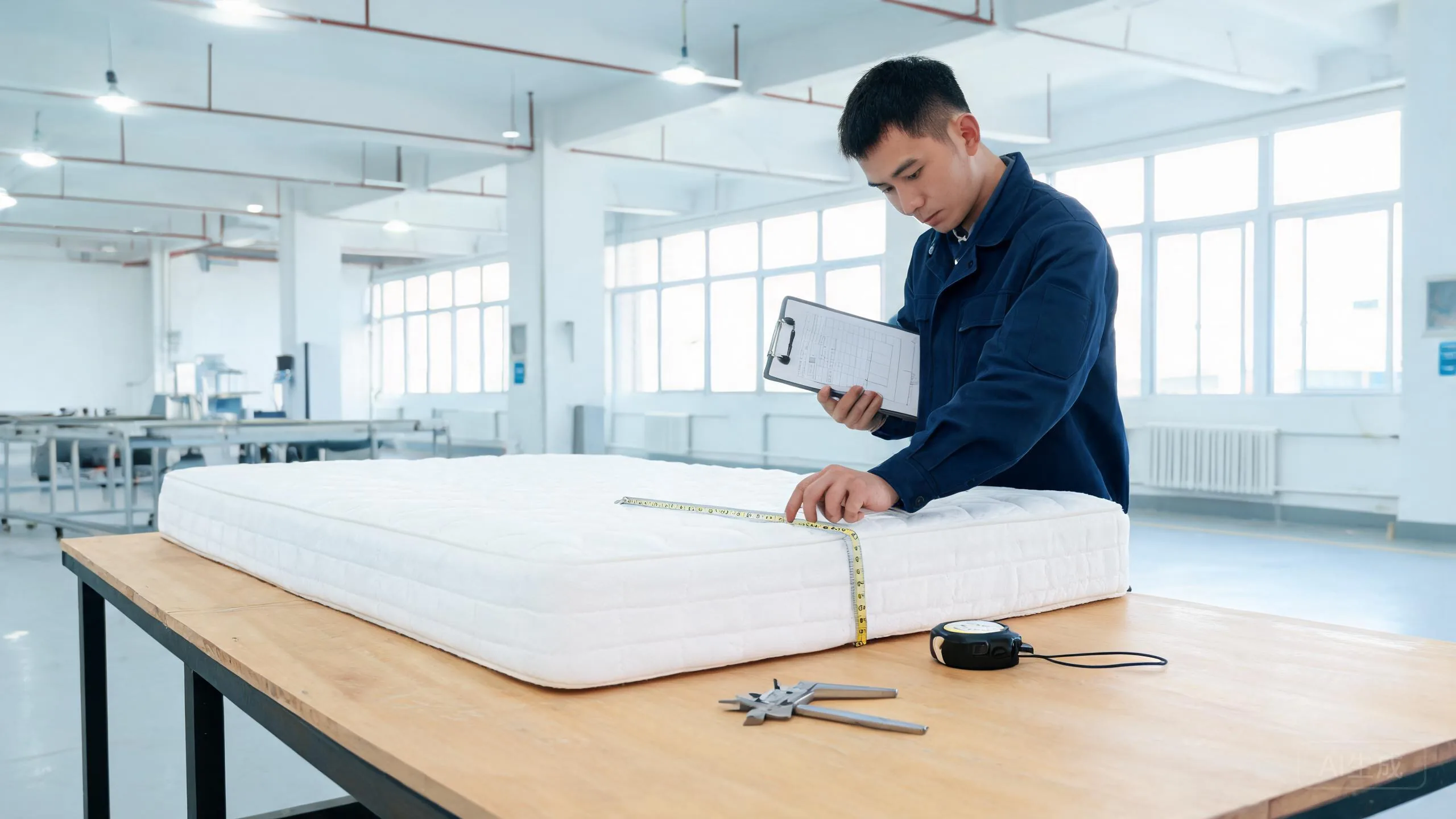
Quick answer: Inspection is four gates, not one. IQC checks incoming materials, IPQC checks the line while the product is being built, FQC checks finished goods against the approved sample, and pre-shipment inspection (PSI) verifies the packed cartons, quantities, marks, dimensions and labels against the order before the container is loaded. For mattresses, the checkpoints that actually prevent claims are firmness and dimension tolerance, filling weight, label correctness and moisture content. Book PSI 7–10 days before ETD so a failed result still leaves time to rework.
A forwarder sees the consequences of weak inspection at the port, not at the factory: cartons that do not match the packing list, weights that change the load plan, labels that stop a customs entry, and goods that arrive with a defect nobody recorded at origin.
The economics are asymmetric:
| Caught at | Cost to fix |
|---|---|
| IQC (materials) | Reject the roll of ticking or the batch of filling |
| IPQC (in-process) | Rework on the line |
| FQC (finished) | Rework plus delay |
| PSI (packed, pre-loading) | Unpack, rework, repack, possibly miss the sailing |
| Destination | Return freight, replacement, air freight, project delay, claim |
Every gate exists to stop a defect moving one step to the right. Container planning starts from the same data the inspection produces, as set out in our guide to industry-specific China shipping.
What is checked before production starts:
The most expensive IQC failure is a substitution. A supplier who swaps a barrier fabric or a filling grade to protect a margin has invalidated the fire test and the fibre label at the same time.
Finished goods, before packing:
Packed goods, before the container arrives:
| Checkpoint | Method | Typical acceptance approach |
|---|---|---|
| Length, width | Tape against the specification, at three points | Agree a tolerance (commonly ±1–2 cm) |
| Thickness | Measured under a defined load, not free-standing | Percentage tolerance agreed per construction |
| Firmness | Indentation hardness at defined points | Tolerance expressed as a percentage of the target |
| Filling weight | Weigh cut filling or verify batch consumption | Match the BOM, not a verbal claim |
| Tufting | Count and tension | Golden sample comparison |
| Ticking | Visual under raking light | No pulls, stains or needle marks |
| Labels | Visual and photo | Fire label, fibre content, importer details |
| Moisture | Calibrated meter, several points | At or below the agreed limit |
| Packaging | Visual, plus seal integrity | No tears, desiccant present |
The golden sample is the anchor for all of this: a sealed, signed, dated unit retained by both sides. Without it, "the firmness feels different" is an opinion, not a nonconformity.
Bulk orders fail on consistency more often than on absolute quality. Three practical controls:
For fire compliance, the tested configuration is the reference. Any material substitution should be treated as a new product requiring a new assessment — not as a purchasing decision.
Most third-party inspections use ISO 2859-1 attribute sampling with an AQL (acceptable quality limit):
| Defect class | Typical AQL | Examples |
|---|---|---|
| Critical | 0 (or a specific zero-tolerance list) | Fire label missing, prohibited substance, safety hazard |
| Major | 2.5 | Dimension out of tolerance, firmness out of range, broken spring |
| Minor | 4.0 | Cosmetic stitching deviation, carton print error |
Sample size follows the lot size and inspection level (commonly general level II). For small, high-value project orders, many buyers add a 100 % check on labels and dimensions even when attribute sampling is used for cosmetics.
| Day relative to ETD | Action |
|---|---|
| −14 to −10 | Production complete; FQC on finished goods |
| −10 to −7 | Third-party PSI booked and performed |
| −7 | Pass: release for loading and book the container |
| −7 to −3 | Fail: rework window, re-inspection |
| −2 | Loading and sealing, photos recorded |
| 0 | Vessel departure |
Booking the container before PSI passes is how projects end up paying rebooking and storage. The inspection result should be a gate in the shipment release process. The same logic applies to the quotation itself: a rate that omits re-inspection, storage or rebooking is not the real cost, as our guide to freight quotes versus final invoices explains.
A PSI report is useful to logistics only if it contains operational data:
Without verified weights and dimensions, the loading plan is guesswork and the container may cube out or weigh out unexpectedly.
For hotel projects, a failed PSI three weeks before opening is a commercial event, not a quality event. Get the buyer and the site team into the decision the same day. How comparable recovery situations have been run is documented in our case files.
If you are shipping a mattress order and want inspection built into the release process rather than bolted on afterwards, send us the order and production schedule and we will align PSI with the sailing.
Q: When should a mattress pre-shipment inspection be booked?
A: Seven to ten days before ETD. Earlier, and the goods may not be finished; later, and there is no rework window before the container is due.
Q: What AQL is normal for mattresses?
A: Criticals at zero tolerance, majors commonly 2.5 and minors 4.0, under ISO 2859-1. Project buyers often add 100 % checks on labels and dimensions.
Q: How is mattress firmness measured for inspection?
A: Indentation hardness at defined points under a defined load, compared with a sealed golden sample and an agreed percentage tolerance.
Q: Does a factory audit replace pre-shipment inspection?
A: No. An audit assesses the system; PSI verifies this specific order. A good factory can still ship a bad lot.
Q: Can inspection be done at the consolidation warehouse instead of the factory?
A: Yes, and for multi-supplier project cargo it often is. But defects found after inland transport are harder to attribute, so factory-level FQC is still recommended.
Inspection standards and tolerances should be agreed in the purchase contract. This article describes common practice, not a contractual specification.

Dec 15,2025
If you're a newly established company in the UAE planning to import goods from China and wants to know what are the best products imported to UAE from China. We will share with you the infomation you need step-by-step. China as the factory of th

Jan 02,2025
With global trade continuously growing, more and more companies in UAE are buying and shipping products from China to the UAE. Particularly in sectors like electronics, machinery, and fashion. And selecting the right shipping method

May 30,2024
Whether you're a small business or a multinational corporation, the efficiency and reliability of your supply chain depend greatly on the expertise and capabilities of your chosen freight forwarder.









 Email:


