
Door-to-Door Shipping From China To The World
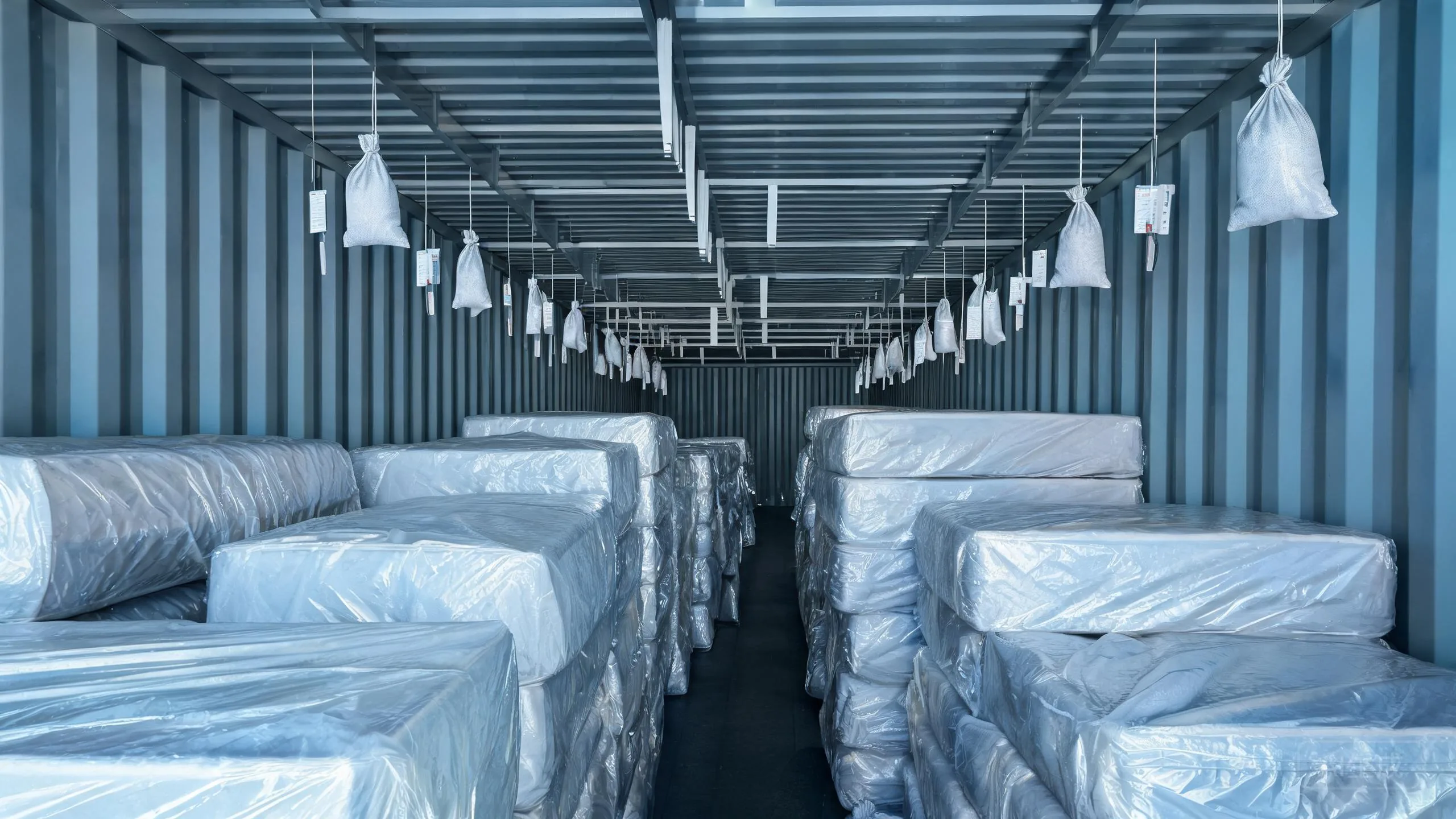
Quick answer: Natural-fiber mattresses arrive mouldy because the cargo, the packaging and the container air all carry moisture, and a steel container crossing climate zones condenses that moisture on its ceiling — "container rain". Prevention is a three-part routine: dry the cargo to a measured moisture content before packing, seal it against re-absorption, and size desiccant to the container volume and voyage length. A 40HQ carrying wool or horsehair goods typically needs roughly 1.5–2.5 kg of desiccant per cubic metre, confirmed with the desiccant supplier for the specific voyage.
Most furniture travels dry. Mattresses made from horsehair, wool, cotton, camel hair, alpaca and silk do not.
These fibres are hygroscopic: they hold water inside the fibre structure, in equilibrium with the surrounding air. Indicative moisture regain at 20 °C and 65 % relative humidity:
| Fibre | Typical moisture regain |
|---|---|
| Cotton | ~8.5 % |
| Silk | ~11 % |
| Wool | ~16–18 % |
| Animal hair (horsehair, camel, alpaca) | Double-digit, wool-like behaviour |
| Polyester / memory foam | <1 % |
Two consequences follow:
This is also why "it was dry when we loaded it" is not a defence in a moisture claim.
Four sources, in descending order of impact:
| Source | What happens | Control |
|---|---|---|
| Cargo | Fibre moisture desorbs into container air as temperature rises | Measure moisture content before packing; dry to target |
| Packaging | Wooden pallets, cardboard cartons, paper labels and starch-based adhesives all release water vapour | Use heat-treated, dry pallets; avoid fresh timber; minimise corrugated mass |
| Container floor and atmosphere | Wooden container flooring holds residual moisture; hot humid air is trapped at loading | Inspect floor for damp and odour; avoid loading in rain or early-morning humidity |
| Voyage climate cycling | Day–night and latitude temperature swings condense moisture on steel surfaces | Desiccant, liners, and route-aware planning |
The first three are controllable at origin. The fourth is physics, and it is what desiccant exists to manage.
A closed steel container behaves like a greenhouse in reverse. During the day, the container heats up; warm air holds more water vapour. At night, the steel ceiling cools faster than the cargo, and the air in contact with it drops below its dew point. Water condenses on the ceiling and roof ribs. When the ship rolls or the temperature rises again, droplets fall onto the cargo. This is container rain. It is normal, it is not a manufacturing defect, and it is the reason ceilings and top layers look worse than the bottom of the load.
Long transpacific or Asia–Europe voyages that cross several climate zones have more condensation cycles than a short intra-Asia leg. A 35-day sailing is not simply "a bit worse" than a 14-day one — it accumulates.
Desiccant quantity is driven by four variables:
A practical planning table, to be confirmed with the desiccant supplier:
| Cargo profile | Planning rate | 20GP (~33 m³) | 40HQ (~76 m³) |
|---|---|---|---|
| Dry goods, short voyage (<20 days) | 0.5–1.0 kg/m³ | 17–33 kg | 38–76 kg |
| Natural fibre, standard voyage (25–35 days) | 1.5–2.0 kg/m³ | 50–66 kg | 114–152 kg |
| Natural fibre, long voyage or heavy packaging (>40 days) | 2.0–2.5 kg/m³ | 66–83 kg | 152–190 kg |
Three practical notes:
The packaging strategy is "seal, then absorb":
Run this at the factory, not at the port.
| Check | Target | Method |
|---|---|---|
| Fibre moisture content | at or below the agreed limit for the fibre blend | calibrated moisture meter, several readings per batch |
| Pallet moisture | visibly dry, no staining or odour | visual plus meter spot check |
| Container floor | dry, no standing water, no musty smell | inspection before loading, photograph |
| Loading conditions | not during rain; avoid the most humid hours | log time and weather |
| Liner and wrap integrity | no tears, full coverage | line inspection |
| Desiccant | correct product, correct mass, correct placement | count and photograph before closing |
| Door seal | gaskets intact, container not over-stuffed at the door | closing inspection |
Photograph every step. In a moisture claim, the difference between a paid claim and a rejected one is usually the loading photo set.
For very high-moisture cargo or extreme humidity routes, a ventilated container allows air exchange so that condensation does not accumulate. The trade-off is that ventilation also admits humid outside air on a humid route, which can be counterproductive without desiccant support.
Rules of thumb:
Container type, availability and transit time all vary by lane, and bedding behaves differently from general cargo on the same route — see our guide to industry-specific China shipping.
Mould risk is not over when the container is opened. A load that sat at 75 % RH for three weeks can develop visible growth several days after devanning in a warm warehouse.
Who carries that loss is a commercial question rather than a physical one: under most trade terms, risk passes to the buyer before the container is opened, so the claim runs against insurance, not the carrier. That is why the evidence file has to start at loading.
Desiccant, liners and vacuum compression all cost money. The comparison that matters is against the alternative:
| Approach | Upfront cost | Risk profile |
|---|---|---|
| No desiccant, standard cartons | Lowest | High; one damaged container can exceed the freight saving |
| Desiccant bags, no liner | Low | Medium; protects air, not surface contact |
| Sized desiccant + inner liner + vacuum compression | Moderate | Low; also reduces freight volume |
| Ventilated container, no desiccant | Moderate | Route-dependent; poor on humid legs |
For high-value natural-fiber mattresses, the third row is almost always the cheapest option per delivered unit.
If you are moving wool, horsehair or cotton mattresses on a long-haul lane and want the packaging, desiccant and container plan reviewed before loading, send us the dimensions, weight and voyage and we will size it.
Q: How much desiccant does a 40HQ need for mattresses?
A: As a planning figure, 1.5–2.5 kg per cubic metre for natural-fiber cargo on a 25–40 day voyage — roughly 114–190 kg for a 76 m³ container. Confirm with the desiccant supplier using the actual cargo moisture and route.
Q: Can vacuum compression prevent mould?
A: It removes air volume and therefore reduces the moisture the packaging must manage, but it does not dry the fibre. Compressing damp goods seals the problem in.
Q: Is container rain the same as a leaking container?
A: No. Container rain is internal condensation from temperature cycling. A leak is a structural defect. Both produce wet cargo, and the evidence you collect differs.
Q: Should mattresses ship in a ventilated container?
A: Usually not. Finished mattresses are better protected in a sealed container with correctly sized desiccant. Ventilation helps when the cargo is still releasing moisture.
Q: What moisture content is acceptable before loading?
A: It depends on the fibre blend and the buyer's specification; the practical rule is to measure against an agreed limit and record it, rather than relying on touch. Cellulosic and protein fibres in double digits need active drying before packing.
Desiccant dosage figures are planning ranges, not a substitute for supplier calculation based on your cargo, packaging and route. Voyage and regulatory conditions vary by lane.

Dec 15,2025
If you're a newly established company in the UAE planning to import goods from China and wants to know what are the best products imported to UAE from China. We will share with you the infomation you need step-by-step. China as the factory of th
Jan 02,2025
With global trade continuously growing, more and more companies in UAE are buying and shipping products from China to the UAE. Particularly in sectors like electronics, machinery, and fashion. And selecting the right shipping method

May 30,2024
Whether you're a small business or a multinational corporation, the efficiency and reliability of your supply chain depend greatly on the expertise and capabilities of your chosen freight forwarder.









 Email:


