
Door-to-Door Shipping From China To The World
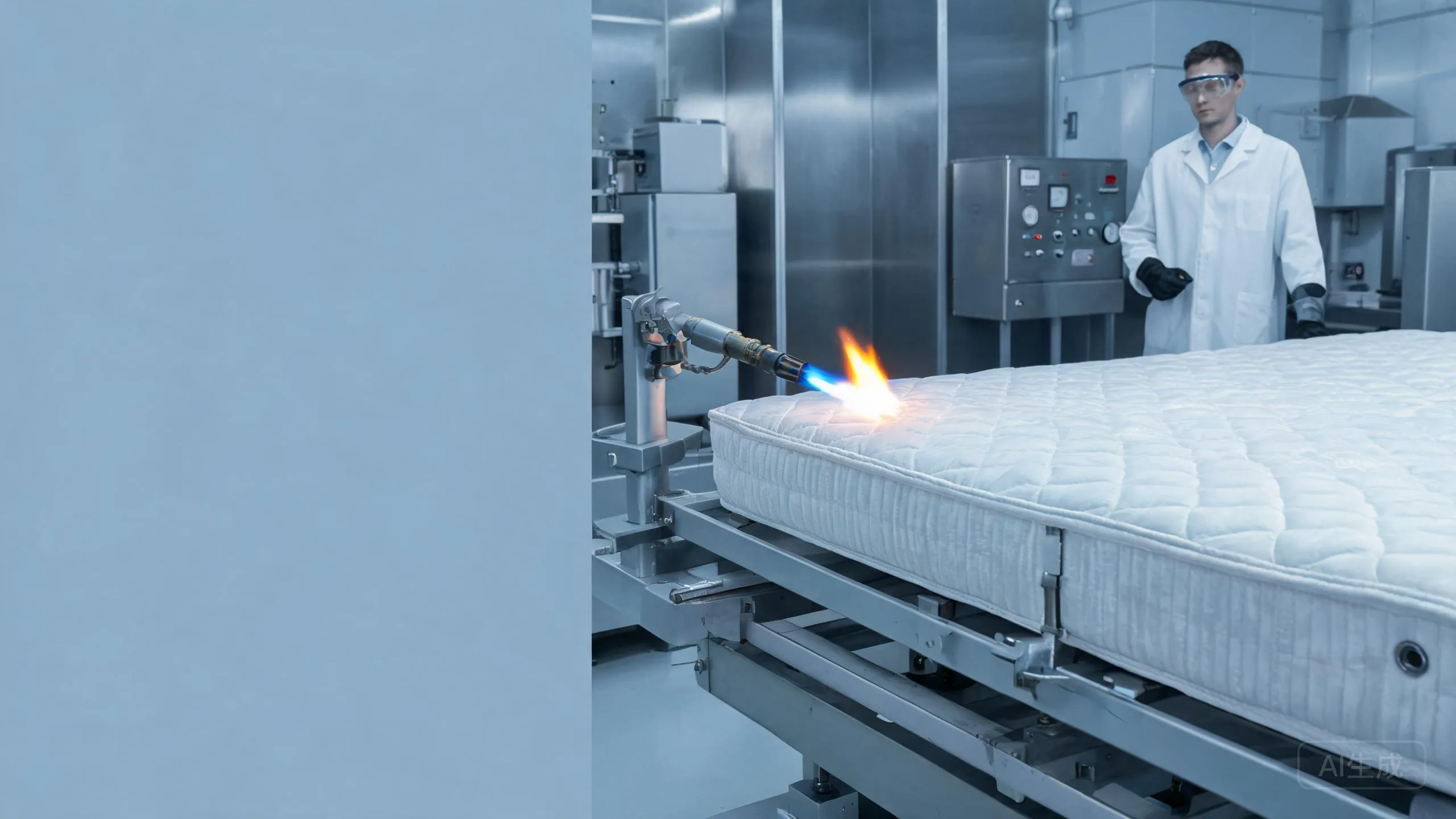
Quick answer: The United States mandates 16 CFR Part 1633 (full-scale open-flame test) and 16 CFR Part 1632 (cigarette ignition) for every mattress set sold. The UK enforces the Furniture and Furnishings (Fire) (Safety) Regulations for domestic goods and, for contract and hotel work, buyers specify BS 7177 hazard categories. The EU has no single mandatory mattress flammability standard: EN 597-1 and EN 597-2 are test methods, and the pass/fail requirement comes from the destination country or the buyer's specification. A shipment can be perfectly manufactured and still be refused, re-tested or recalled because the wrong report is attached.
This guide is written from the shipping side of the transaction — what the forwarder, the importer of record and the project buyer each need to see before a container is booked.
Mattresses are one of the few furniture categories with destination-specific ignition regulation. Three things go wrong repeatedly:
None of these are visible on a packing list. They surface at the customs broker, at the hotel's pre-opening inspection, or months later in a recall.
The US regime is mandatory federal law, enforced by the Consumer Product Safety Commission (CPSC).
| Rule | What it covers | Test type | Pass criteria |
|---|---|---|---|
| 16 CFR 1632 | Ignition resistance to a smouldering cigarette | Component/small-scale | No ignition of the mattress |
| 16 CFR 1633 | Open-flame resistance of the mattress set (mattress + foundation) | Full-scale | Peak heat release rate ≤ 200 kW and total heat release ≤ 25 MJ within the first 10 minutes |
Key points that decide whether a container clears:
For a hotel project, the specification usually adds a clause requiring the supplier to warrant 16 CFR 1633 compliance and to supply the test report plus label artwork before production release.
The fire report is only one line of the destination document set. Entry mechanics, labelling and the EU/UK obligations are set out in our guide to importing mattresses into the US, EU and UK.
The UK has two layers, and they are often confused.
Layer 1 — domestic law. The Furniture and Furnishings (Fire) (Safety) Regulations 1988 (as amended) apply to mattresses sold to consumers. They require resistance to both a smouldering cigarette and a match-flame equivalent.
Layer 2 — contract specification. For hotels, serviced apartments and commercial projects, buyers specify BS 7177, which defines four hazard categories and the ignition sources each must resist.
| BS 7177 hazard category | Typical setting | Ignition sources required |
|---|---|---|
| Low | Domestic / low-risk | BS EN 597-1 (cigarette) + BS EN 597-2 (match) |
| Medium | Hotels, guest houses, offices | BS EN 597-1 + BS EN 597-2 |
| High | Public buildings, high-occupancy | Above, plus BS 5852 crib 5 |
| Very High | Higher-risk public spaces | Above, plus BS 5852 crib 7 |
Practical consequence: a mattress with only cigarette and match performance can satisfy a domestic buyer and fail a hotel specification that names High hazard. The HS code and the invoice look identical. The purchase order is what tells you which category applies — so get the spec sheet before quoting freight, not after.
This is the single most misunderstood point in mattress export compliance.
Both are methods. They specify apparatus, airflow, specimen preparation and the observation procedure. They do not, by themselves, set a legal pass/fail threshold across the EU. There is no harmonised EU-wide mandatory mattress flammability standard comparable to 16 CFR 1633.
What actually governs a shipment into the EU:
So the correct question is never "is it EN 597 compliant?" It is "which country, which building type, and what does the specification name?"
| Dimension | US (16 CFR 1633 / 1632) | UK (1988 Regs + BS 7177) | EU (EN 597-1/-2) |
|---|---|---|---|
| Legal status | Mandatory federal rule | Mandatory for domestic; BS 7177 by contract | Test methods; national rules and specs apply |
| Unit tested | Mattress set (mattress + foundation) | Mattress / mattress set per category | Specimen per method |
| Signature test | Full-scale open flame | Cigarette, match, crib 5/7 by category | Cigarette and match methods |
| Quantitative threshold | ≤ 200 kW peak, ≤ 25 MJ total in 10 min | Pass/fail per ignition source | Method-defined observation |
| Label required | Yes, permanent label | Depends on regime and buyer | Buyer/spec dependent |
| Typical hotel requirement | 1633 report + label artwork | BS 7177 Medium or High certificate | EN 597-1/-2 reports + spec confirmation |
Ask for these at quotation stage. Collecting them after the container is loaded is how delays become demurrage. They sit on top of the standard import document set — invoice, packing list, bill of lading and certificate of origin — not in place of it.
For projects, add the buyer's specification clause to the file. It is the only document that tells you whether "Medium" or "High" hazard applies.
| Failure | Root cause | Prevention |
|---|---|---|
| US entry query on a 1633 shipment | Report covers the mattress only, not the set | Confirm foundation pairing in the report |
| Hotel rejects goods at inspection | EN 597 report offered instead of BS 7177 category | Match the specification before production |
| Retail recall risk | Design changed after testing | Freeze the BOM at test date; retest on change |
| Label non-conformity | Label artwork never reviewed | Approve artwork with the PO |
| Inconsistent production | Prototype tested, mass run differs | Sample the production batch, not the prototype |
| EU delivery blocked | No EU responsible operator named under GPSR | Confirm the importer of record and labelling before sailing |
Fire compliance is not a paperwork afterthought — it changes routing and timing:
If you are shipping mattresses, upholstered bed bases or bedding into the US, UK or EU and want the document set reviewed before booking, send us the specification and we will map the compliance route with the freight plan.
Q: Is EN 597 the same as BS 7177?
A: No. EN 597-1 and EN 597-2 are test methods. BS 7177 is a UK specification that sets hazard categories and references those methods (plus BS 5852 crib tests for higher categories).
Q: Can a mattress pass EN 597 and still fail US import?
A: Yes. US law requires a full-scale test of the mattress set under 16 CFR 1633 with quantitative heat-release thresholds. A European cigarette/match report does not satisfy it.
Q: Does 16 CFR 1633 apply to the mattress alone?
A: It applies to the mattress set as sold — mattress plus foundation. Testing only the mattress is an incomplete submission.
Q: Do hotel mattresses in the UK need BS 7177?
A: It is normally a contractual requirement rather than a standalone law. Most international hotel groups specify BS 7177 Medium or High in the FF&E package.
Q: How long does a new flammability test take?
A: Typically two to four weeks including sample preparation and laboratory scheduling, plus re-engineering time if the first result fails. Plan it before, not during, the shipping window.
Standards and regulations change. Confirm the current text of 16 CFR 1632/1633, the UK Furniture and Furnishings Regulations and your destination's national rules before production release. This article is operational guidance for shipping and procurement, not legal advice.

Dec 15,2025
If you're a newly established company in the UAE planning to import goods from China and wants to know what are the best products imported to UAE from China. We will share with you the infomation you need step-by-step. China as the factory of th
Jan 02,2025
With global trade continuously growing, more and more companies in UAE are buying and shipping products from China to the UAE. Particularly in sectors like electronics, machinery, and fashion. And selecting the right shipping method
May 30,2024
Whether you're a small business or a multinational corporation, the efficiency and reliability of your supply chain depend greatly on the expertise and capabilities of your chosen freight forwarder.







 Email:


