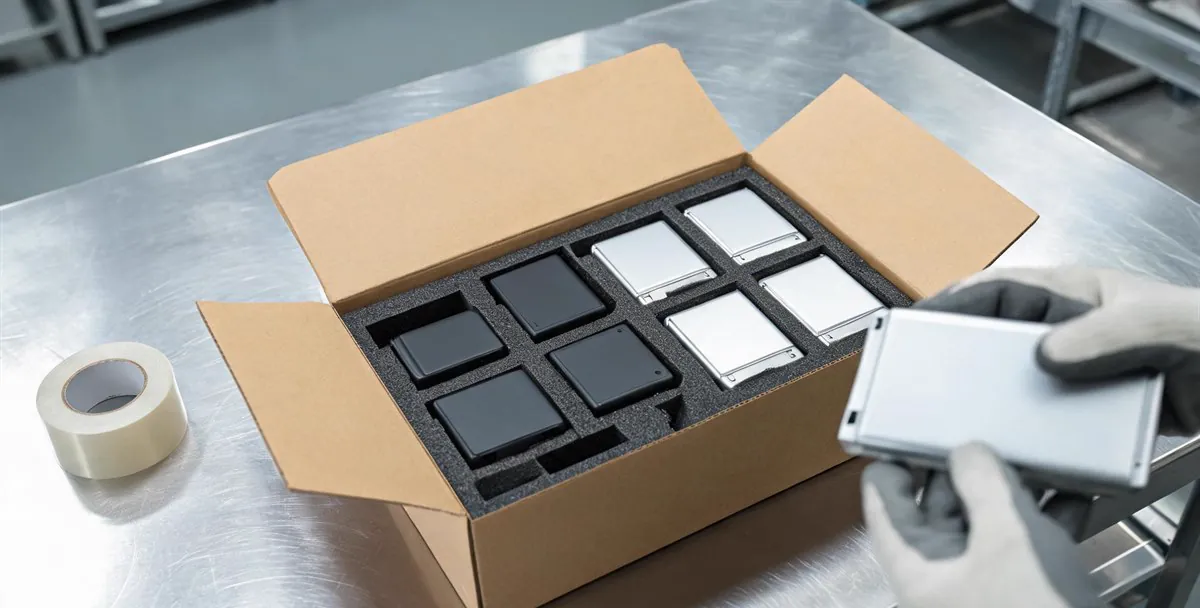
Direct answer: Yes — but only as regulated dangerous goods, never as ordinary cargo. You need a valid UN38.3 test report, an MSDS (SDS), and proper packing/labeling, and the rules differ by battery type: embedded (inside a device), packed with (separate but in the same package), or standalone (loose cells/power banks). Standalone lithium batteries generally ship as cargo only under strict state-of-charge limits, and many carriers restrict or refuse them. Get the documents and classification right before you book.
By the Dangerous Goods & Air Operations team, Baton Logistics — we handle battery and power-bank air shipments daily; the most common failure is booking first and asking for paperwork second.
Air carriers and IATA classify lithium batteries by how they travel:
| Category | Example | Typical air treatment |
|---|---|---|
| Embedded / contained | Phone with non-removable battery; laptop | Usually simplest; device-level rules |
| Packed with equipment | Spare battery in the same box as a camera | Must meet packing + marking rules |
| Standalone / loose | Power banks, loose 18650 cells | Strictest; state-of-charge and carrier limits apply |
Baton's dangerous-goods handling sits within our Air Freight service. Always declare batteries — hiding them is the fastest way to get a shipment destroyed and fined.
Verify against current IATA DGR and your airline's variation. The table shows what is commonly required; the carrier's acceptance is final.
| Document | Embedded | Packed-with | Standalone | Notes |
|---|---|---|---|---|
| UN38.3 test report | Required | Required | Required | Per cell/battery model, valid test |
| MSDS / SDS | Required | Required | Required | 16-section safety data sheet |
| DG declaration (Shipper's) | May apply | Required | Required | IATA form, signed |
| Packaging test report (UN spec) | Per design | Required | Required | UN-rated packaging |
| Lithium battery handling label | Required | Required | Required | Class 9, UN3480/UN3481 |
| State-of-charge statement | — | Often | Often | Usually ≤30% for standalone |
Rules move quickly. Treat any figure or category above as a starting point and confirm with the handling station before booking. See also our UAE shipping guide.
Q: Can I ship power banks from China by air freight?
A: Yes, as regulated dangerous goods. You need a UN38.3 report, MSDS, proper UN packaging, and the correct Class 9 label, and the airline must accept standalone batteries on your lane.
Q: What is a UN38.3 test report?
A: A laboratory test report proving a lithium cell or battery passed the UN Manual of Tests and Criteria (altitude, thermal, vibration, shock, etc.). Each battery model needs its own valid report.
Q: Is MSDS the same as UN38.3?
A: No. MSDS/SDS describes the material's hazards and handling; UN38.3 proves the battery passed safety tests. Both are usually required.
Q: Why do some battery shipments get rejected?
A: Most often a missing or invalid UN38.3 report, wrong labeling, non-UN packaging, state-of-charge over the limit, or the carrier's embargo on standalone lithium on that route.
Mar 09,2022
At the beginning of the new year, the most frequently asked question after work is about RCEP. I really want to write an article to introduce it to you, but my ability is limited, and the scope of RCEP is too large. I can only answer some of the most freq
Mar 09,2022
Yes, our service cover all major ports in China areas , like Shanghai / Qingdao / Ningbo/Shenzhen/Guangzhou/Hong Kong etc, Our warehouse facility in these ports are more than 5,000 square meter.
Mar 09,2022







 Email:


