
Door-to-Door Shipping From China To The World
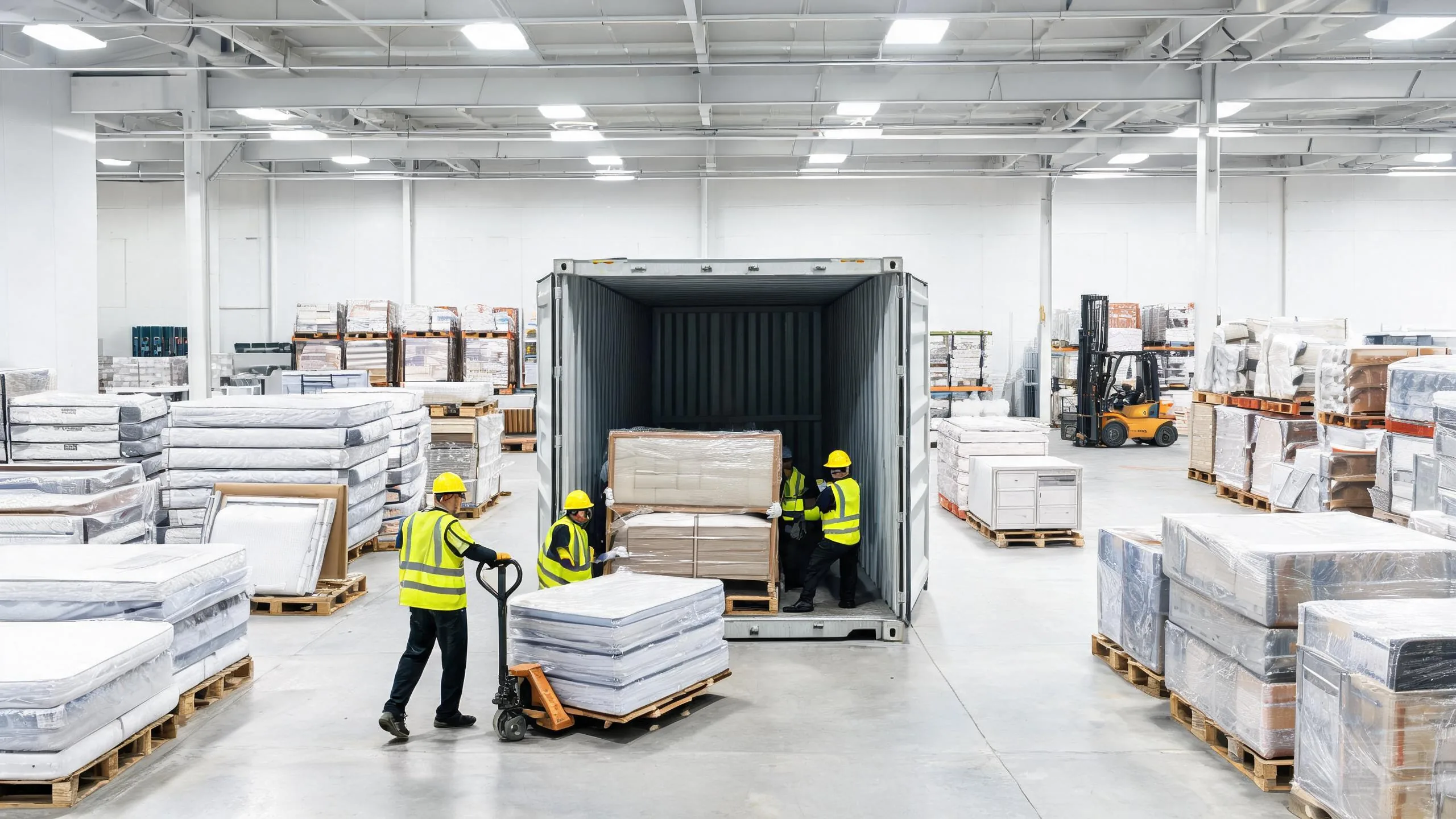
Quick answer: A hotel FF&E shipment is not one import — it is ten to forty small imports with a single opening date attached. The work is consolidation: collect goods from multiple factories into one warehouse, inspect and re-pack them, build containers around the room list and the site's delivery sequence, then clear and deliver to a building that is still under construction. The failure mode is almost never freight cost; it is a missing line item, a late factory, or a container that arrives in the wrong order.
| Category | Examples | Logistics behaviour |
|---|---|---|
| FF&E (furniture, fixtures and equipment) | Beds, mattresses, wardrobes, casegoods, seating, lighting | Long lead times, bulky, damage-sensitive, room-specific |
| OS&E (operating supplies and equipment) | Linen, towels, amenity, kitchen smallwares, housekeeping carts | Short lead times, high SKU count, low unit value |
FF&E drives the container plan. OS&E is usually consolidated separately and shipped closer to opening. Mixing them in one container looks efficient on paper and creates a warehouse problem on site.
A normal importer ships what they bought. A hotel project ships what the building needs, in the order the building needs it, against a date that cannot move because it is a public opening.
Four structural differences:
Build a single table: supplier, SKU, quantity per room type, promised ready date, packed dimensions, gross weight, destination room/floor.
Then convert promised dates into pickup dates with a buffer. A factory that says "ready on the 15th" usually means "ready for inspection on the 15th". Book pickup after inspection, not before.
The same consolidation logic applies before the main order, when samples and mock-up goods come from several factories — our guide to consolidating samples from multiple suppliers covers that stage.
Goods arrive from many factories. At receiving, record:
Discrepancies must be raised the same day. A shortage found at the warehouse costs a phone call; the same shortage found at the hotel costs air freight.
For mattresses and upholstery, inspection at consolidation is the last practical point to catch:
Repacking matters for project cargo because factory cartons are designed for a clean warehouse, not for a construction site. Corner protection, inner moisture barriers and clear room labelling are added here.
The container plan is built around the delivery sequence, not around cubic efficiency alone:
For a 200-room property, compressed mattresses at roughly 0.3 m³ each represent about 60 m³ — most of a 40HQ before bed bases, spares and casegoods are counted. The container loading calculator is the right starting point for the first estimate.
Two structures are common:
| Structure | Who clears | Best for |
|---|---|---|
| DAP to port or site | Buyer/importer of record | Owners with a local entity and customs broker |
| DDP to site | Seller or forwarder | Buyers without an import entity, at a higher all-in price and higher compliance risk |
Project cargo often includes samples, mock-up room goods and replacements. Those may need different treatment from the main shipment — confirm before they are consolidated into a container, because mixing them can change the entry.
The last mile is where hotel projects lose days:
| Milestone | Working backwards from opening |
|---|---|
| Final installation and snagging | −3 weeks |
| Last FF&E delivery to site | −4 to −5 weeks |
| Customs clearance and local delivery | −5 to −6 weeks |
| Ocean transit | −6 to −11 weeks |
| Container loading | −11 to −12 weeks |
| Warehouse receiving and inspection | −12 to −14 weeks |
| Factory production complete | −14 to −18 weeks |
| Purchase orders placed | −18 to −24 weeks |
Add a buffer for the Chinese New Year window if production falls anywhere near it — factories close for two to four weeks and freight capacity tightens. Our Chinese New Year timeline sets out the cut-offs.
Transit time is not a single number either: lane, carrier and transhipment all move it, and delays are usually visible before they become late deliveries. Our guide to transit times and delay handling explains how to read the schedule.
Consolidation is not free. It adds warehouse handling, inspection and re-packing, and it delays each supplier's goods until the container is complete. Compare honestly:
| Approach | Cost profile | Risk profile |
|---|---|---|
| Direct FCL per supplier | Lowest per-unit freight if each supplier fills a box | Multiple arrivals, no single inspection point, site congestion |
| Consolidated FCL | Warehouse and handling fees | One arrival, one inspection, sequencing possible |
| Multiple LCL | High per-unit freight and handling | Highest damage risk; slowest overall |
For projects above roughly 30 m³, a consolidated FCL is usually both cheaper and safer. Below that, LCL or a shared container may be the only option.
| Risk | Early warning | Mitigation |
|---|---|---|
| Factory late | Missed inspection date | Weekly production check; book pickup after inspection |
| Short shipment | Carton count mismatch at receiving | Same-day reconciliation against the room list |
| Damage in transit | Poor packing, mixed stacking | Repack at warehouse; corner protection; all-risks insurance |
| Wrong delivery sequence | Container plan built on cubic efficiency only | Load in reverse delivery order |
| Customs hold | Incomplete documents, label errors | Pre-shipment document review; see our import document guide |
| Site access failure | No lift or bay booking | Delivery appointments confirmed with the main contractor |
With those six items, a container plan and a delivery schedule can be built before the first carton is finished. How comparable programmes have run in practice is documented in our case files.
If you are running a hotel or serviced-apartment FF&E programme out of China, send us the room matrix and supplier list and we will build the consolidation and delivery plan against your opening date.
Q: How many containers does a 200-room hotel FF&E shipment need?
A: It depends on casegoods and bases, but compressed mattresses alone are roughly 60 m³ for 200 rooms — close to a 40HQ. Most projects run to several containers plus a separate OS&E shipment.
Q: Should mattresses ship in the same container as casegoods?
A: Generally no. Mattresses are moisture- and damage-sensitive; hard casegoods can crush or abrade them. If they must share, mattresses go on top and away from hard edges, with protection.
Q: Can multiple suppliers be consolidated into one container?
A: Yes, that is the core of project logistics. Each supplier delivers to a consolidation warehouse, goods are inspected and re-packed, then loaded in delivery sequence.
Q: What Incoterm is usual for hotel FF&E?
A: DAP to site is common where the owner has a local import entity. DDP is used where they do not, but it concentrates compliance risk on the seller.
Q: How early should FF&E ship before opening?
A: Allow four to six weeks between the last delivery and opening for installation and snagging, which puts container loading roughly three months before the opening date.
Timelines and cost structures vary by project. The sequence above is a planning framework, not a fixed schedule.

Dec 15,2025
If you're a newly established company in the UAE planning to import goods from China and wants to know what are the best products imported to UAE from China. We will share with you the infomation you need step-by-step. China as the factory of th
Jan 02,2025
With global trade continuously growing, more and more companies in UAE are buying and shipping products from China to the UAE. Particularly in sectors like electronics, machinery, and fashion. And selecting the right shipping method
May 30,2024
Whether you're a small business or a multinational corporation, the efficiency and reliability of your supply chain depend greatly on the expertise and capabilities of your chosen freight forwarder.









 Email:


